
There are filmmakers whose early work you watch with the specific attention you give a person who is clearly learning something in public — whose films are good in parts, coherent in intention, but not yet fully themselves. Taiwo Egunjobi has been one of those filmmakers since In Ibadan in 2020. All Na Vibes (2021) opened NollywoodWeek Paris and showed range. A Green Fever (2023) deepened the Ibadan-as-moral-landscape vision. The Fire and The Moth (2025) is the film where the learning stopped and the filmmaking started. His fourth feature, which premiered at NollywoodWeek Paris and is now on Prime Video, is not the work of someone building toward a style. It is the work of someone who has arrived at one.
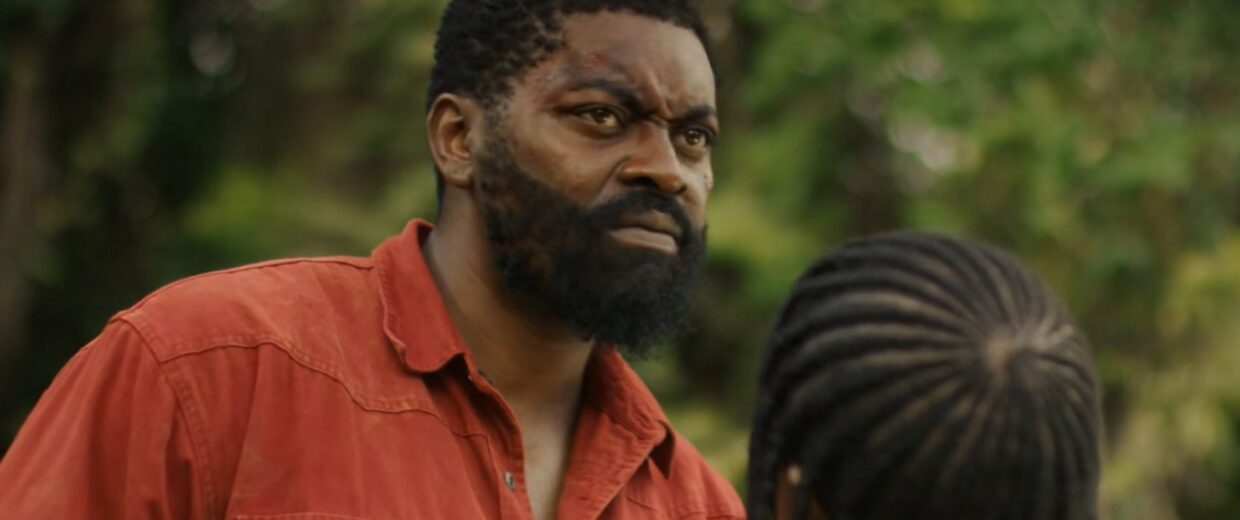
The premise: Saba (Tayo Faniran), a hired smuggler in a western Nigerian border town, is given the task of transporting a stolen Ife bronze head to Francois, an international art dealer with more patience than he initially shows. What appears to be a routine operation unravels when Saba fails to pay tribute to Opa Stephen (Olarotimi Fakunle), the corruption-drunk local police officer who runs the territory. Francois, growing impatient, dispatches a nameless Contractor (Jimmy Jean-Louis) armed with a flamethrower. Everything that follows is the consequence of things that should not have been set in motion.
The film’s central motif — the Ife bronze head itself — is the most intelligent device Egunjobi has deployed in his career. The head is not merely a MacGuffin. It is a carrier of history, in the specific sense that the actual Ife bronzes — 12th to 14th century Yoruba artefacts whose discovery in 1938 fundamentally challenged colonial narratives about African civilisation’s capacity for sophisticated metalwork — carry history in a way that their mere monetary value does not exhaust. For Francois, the head is a commodity. For corrupt policeman Opa Stephen, it is generational wealth. For the idealistic Teriba Bello (William Benson), it is a symbol of cultural plunder and moral decadence. For Abike, it is the promise of her sister’s future. The head takes a different meaning from each hand it passes through, and leaves damage in each. The Afrocritik review compared its trajectory to The Treasure of the Sierra Madre. The comparison earns its place.
What Egunjobi Does with the Camera
The cinematography, by Egunjobi’s long-time collaborator Okwong Fadama, establishes the tone before a word is spoken. The border town is shot with aerial grandeur that sits in deliberate contrast with the violence that will tear through it. The calmness is the point — this is a town that considers itself quiet, and Fadama’s camera shows you the quiet before the film shows you what the quiet is concealing. The interior spaces are tight and practical. The forest sequences carry genuine menace. The film has been compared to No Country For Old Men in several reviews, and the comparison is not wrong — the Contractor, with his flamethrower and his methodical terror, has Anton Chigurh’s quality of imported doom — but it is not complete. The Contractor is Chigurh’s disciplined counterpart rather than his philosophical twin: brought in to impose order rather than to celebrate chaos. The distinction is what makes him feel Nigerian rather than transplanted.
The dialogue, by writer Isaac Ayodeji — Egunjobi’s recurring collaborator — is spare and direct. It never rings false. There are no smartphones, only basic cell phones. Vehicles and homes appear worn and lived-in. The grim realism is consistent and serves the film’s argument: the corruption and violence depicted here are not spectacular. They are local and daily and generations old.
Where It Strains
The final act does not fully deliver on the tension the earlier sequences build. The climactic chase lacks the kinetic energy the build-up earns. Some character motivations, while intelligible, are not developed to the depth their weight in the story requires. Egunjobi is not yet making films that close with the same force they open. This is the only limitation that matters, and it is the limitation of someone still growing — which means the next film is the argument. Everything else in The Fire and The Moth demonstrates a filmmaker who has found his identity clearly enough to execute it at high quality.
The Fire and The Moth (2025) · Dir. Taiwo Egunjobi · Nigeria · 99 min · Prime Video · Nemsia Films / Sable Productions · Stars: Tayo Faniran, Jimmy Jean-Louis, Ini Dima-Okojie, Olarotimi Fakunle, William Benson, Keppy Ekpenyong-Bassey