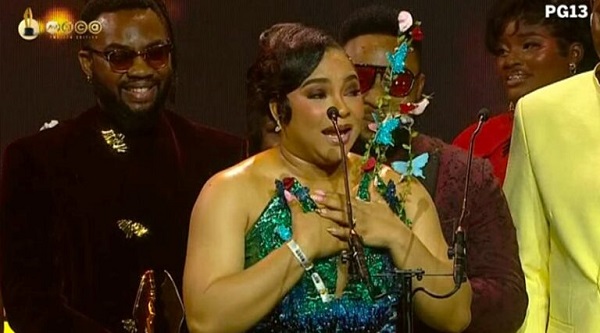
At some point on Saturday night, between winning Best Supporting Actress for The Herd and returning to the same stage to collect Best Lead Actress for The Serpent’s Gift — a sequence of events that no actress had managed in the twelve editions of the AMVCA before her — Linda Ejiofor-Suleiman said something in her acceptance speech that deserves more attention than the record itself.
“I prayed to God that I wanted a role that would challenge me.”
Not a role that would make her famous. Not a role that would generate press. Not a role that would win her something. A role that would challenge her. The distinction is not rhetorical. It is the specific grammar of a performer who has been doing this for seventeen years and understands, at a level that experience alone produces, that the work precedes the recognition by a margin that only patience can bridge.
Two awards in one night. First actress in AMVCA history to hold both simultaneously. Competitive field that included Bimbo Akintola, Sola Sobowale, Funke Akindele, and Bisola Aiyeola. Two different films. Two different directors. Two completely different characters.
Was it a surprise?
Only if you were not watching.
I. What Tinsel Actually Was
In 2008, Linda Ejiofor walked into an audition for M-Net’s Tinsel and was cast as Bimpe Adekoya — an ambitious, mischievous, accident-prone character in the Nigerian television industry’s longest-running serial drama. She played that character for seventeen years. Three thousand, two hundred and eighty-five episodes.
The industry has a way of talking about soap opera experience that simultaneously acknowledges its volume and dismisses its value. The word “training” gets used — she trained on Tinsel — as though the training is the point and the work itself is the preparation for something that matters more. That framework is wrong, and it is wrong in a way that specifically affects how we evaluate the careers of actresses who build their foundations in long-form television.
What Tinsel actually gave Linda Ejiofor was not training in the abstract. It gave her a specific and largely unreplicable form of technical discipline: the ability to be specific in conditions of repetition. Three thousand episodes means three thousand times that the camera was there and she had to be present — not marking time, not going through the motions, not running on memory of how the character moved last week, but actually present in a scene, with material that was sometimes excellent and sometimes barely adequate, finding something worth playing inside whatever she had been given that day. That discipline does not announce itself. It accumulates. And then one day it is visible in ways that a jury cannot articulate but cannot ignore.
The other thing Tinsel gave her was failure. Or more precisely: the regular experience of material that did not cooperate. A soap opera, across seventeen years of continuous production, delivers more bad days than good ones. Scripts that do not quite work. Scenes that cannot be saved by performance alone. Characters who exist to serve plot functions that have no emotional logic. An actress who survives that and continues to bring specific internal life to what she is given has developed something that a good script can reveal but cannot produce. It is already inside the performer when the good material arrives.
By the time Linda Ejiofor walked into her first film audition in 2012, she had been doing this daily for four years. The craft was already resident.
II. The Meeting and What It Announced
Her film debut, in Amma Asante’s —
Wait. The Meeting was a Nollywood production, directed and produced within the industry, not Amma Asante. Let me be precise. She debuted in the 2012 romantic comedy drama as Ejura — described at the time as a wild-eyed, idealistic youth corper — in a film that also featured Rita Dominic. The role earned her a nomination for Best Actress in a Supporting Role at the 9th Africa Movie Academy Awards. She was listed that year among the ten fastest-rising Nollywood stars of 2013.
The nomination is worth noting for what it was not. It was not for a starring role. It was not for a film built around her. It was for a supporting performance in an ensemble where she shared screen time with Rita Dominic, which is not the easiest context for a debut. To hold your own in that specific company, in your first film, while also managing the transition from television’s pace and register to the entirely different demands of cinematic performance — that requires something the AMAA jury noticed.
Then in 2015 she won Best Supporting Actress at the AMVCA for The Meeting. Her first AMVCA. Three years into her film career, seven years into her professional acting life. The ceremony gave her the award. The ceremony then, for reasons that are worth examining, moved on.
III. The Decade Between
What happened between 2015 and 2025 is the actual story of Linda Ejiofor’s career, and it is the story that nobody was telling with sufficient seriousness until Saturday night made it impossible to avoid.
She kept working. Consistently, steadily, without the kind of awards recognition that consolidates industry attention around a performer and generates the feedback loop of better material attracting better roles attracting better material. Out of Luck in 2015 — in the top twenty highest-earning films of that year, and she received an AMAA nomination for Best Lead Actress. Secret Room in 2013. Heroes and Zeroes in 2014. Ojukokoro in 2017, which remains one of the more undeservedly overlooked pieces of ensemble work in Nollywood’s mid-period. Chief Daddy in 2018. Knockout Blessing in 2018. 4th Republic in 2019. Throughout this period, her film choices show something that is only legible in retrospect: a performer consistently gravitating toward dramatic material, toward roles that require internal weight, toward women navigating systems that are not designed to accommodate them. She was not making the obvious commercial calculation. She was making a different kind of calculation.
The industry, for much of this decade, treated her as a working actress who was reliable without being remarkable. That assessment was inaccurate. It was the assessment you make about a performer when you are watching their category rather than watching their work. She was building a specific instrument. The instrument does not advertise itself while it is being built. It announces itself when the right material arrives.
Then, in 2025, two pieces of right material arrived within months of each other.
IV. Ijeoma Sylvanus and Adamma
The Serpent’s Gift and The Herd are, as films, nothing alike. They share Linda Ejiofor-Suleiman as an actress and essentially nothing else. The fact that the same performer gave the AMVCA jury reasons to vote for her in both is not a coincidence. It is a demonstration.
Ijeoma Sylvanus in The Serpent’s Gift — directed by Kayode Kasum — is a widow in Eastern Nigeria whose husband’s death does not bring her grief and support but immediate, organised hostility from his family. She is cast as suspect and enemy simultaneously, navigating an inheritance war in which blood ties have become weapons and mourning is something she cannot afford because everyone around her is watching to see if it is genuine. Kayode Kasum has described the production’s challenge as one of cultural authenticity — the film is set in a world with specific registers of grief, of power, of femininity — and Ejiofor had to learn the internal logic of a character whose composure is not composure at all but a survival strategy conducted under continuous surveillance.
The character that the jury rewarded for Best Lead Actress is a woman who cannot be read. Not because she is opaque but because she has made herself illegible as a form of protection. The acting challenge is to make an audience understand the interior of someone who cannot reveal her interior to anyone in the film. That is a specific and difficult technical problem. It requires knowing precisely how much to show and when — and the answer is almost never, and almost never is not the same as nothing.
Adamma in The Herd is a different problem entirely. She is not hiding. She is searching. Her husband has been taken. There is a ransom she cannot pay. There are family members around her who should be helping and are not, because their reasons for withholding are their own and have nothing to do with her emergency. She has to navigate a financial crisis and a personal crisis and a social crisis simultaneously, in real time, without the protection of knowing how any of it ends. Daniel Etim Effiong, who directed The Herd and has spoken publicly about the specific demands he placed on his cast, built a film around the texture of sustained anxiety — the way that a sustained crisis changes how people move and speak and make decisions. Adamma had to carry that texture without losing the audience’s sympathy for a woman who is frightened and occasionally gets it wrong and keeps going anyway.
Two characters. Two entirely different emotional registers. Two different relationships to the camera. Two different kinds of watching that the jury had to do to evaluate the performances. In both rooms, the same actress won.
V. What a Competitive Field Actually Means
The field Linda Ejiofor-Suleiman beat on Saturday night deserves its own sentence, because it is the context that makes the result legible as a verdict rather than an accident.
Best Supporting Actress — she won over Funke Akindele, Bisola Aiyeola, Sola Sobowale, and Olamide Kidbaby. That is not a weak category. Funke Akindele’s nomination was for Behind The Scenes, a film in which she is also the director — the intensity of someone carrying that film from both positions is present in her performance. Bisola Aiyeola’s work in Gingerrr, as we have argued elsewhere, is precise and assured. Sola Sobowale’s nomination was for The Covenant Series, which is a career built on exactly this kind of material. The jury looked at all of them and chose Linda Ejiofor-Suleiman’s Adamma. That is a strong choice, made against strong competition.
Best Lead Actress — she won over Bimbo Akintola, Genoveva Umeh in The Herd, Ifeoma Fafunwa, Sola Sobowale again, and Scarlet Gomez. Genoveva Umeh’s performance in The Herd generated significant critical discussion — her work in that film is a genuine achievement, and the nomination acknowledged it. Bimbo Akintola does not require introduction. The jury chose Ejiofor-Suleiman’s Ijeoma.
To beat those specific performers, in those specific categories, in the same night, requires that you have delivered two performances whose individual quality is simply higher than the competition. The jury does not give out historical recognition. It votes on what is in front of it. What was in front of it on Saturday was an actress whose output in 2025 represented the fullest expression of a craft built across seventeen years, and the jury recognised it twice.
VI. The Answer
Was Saturday night a surprise?
The honest answer is: it was a surprise in the way that anything is a surprise when it happens for the first time. The ceremony has never seen a double like this. The record is real. There is nothing diminishing about calling the first instance of something unprecedented.
But the quality that produced the record is not unprecedented. It is the natural output of a specific kind of working life — one organised around the work rather than the recognition of the work, one willing to spend a decade building an instrument in conditions that do not announce its value, one that asks, even on the night it wins two awards at the continent’s most prominent ceremony, not for celebration but for challenge.
“I prayed to God that I wanted a role that would challenge me.”
She has been saying that prayer for a long time. In the Tinsel studio, across three thousand episodes of a character who demanded daily specificity. In the film auditions of 2012 and the years after, choosing material that asked something of her rather than material that would be easy to carry. In the decade between the first AMVCA and the second, continuing to show up for the work while the awards conversation drifted toward other names.
The AMVCA did not discover Linda Ejiofor-Suleiman on Saturday night. It confirmed what the work had been saying for years to anyone who was watching closely enough.
Some of us should have been watching more closely. The ceremony, at least, was paying attention.