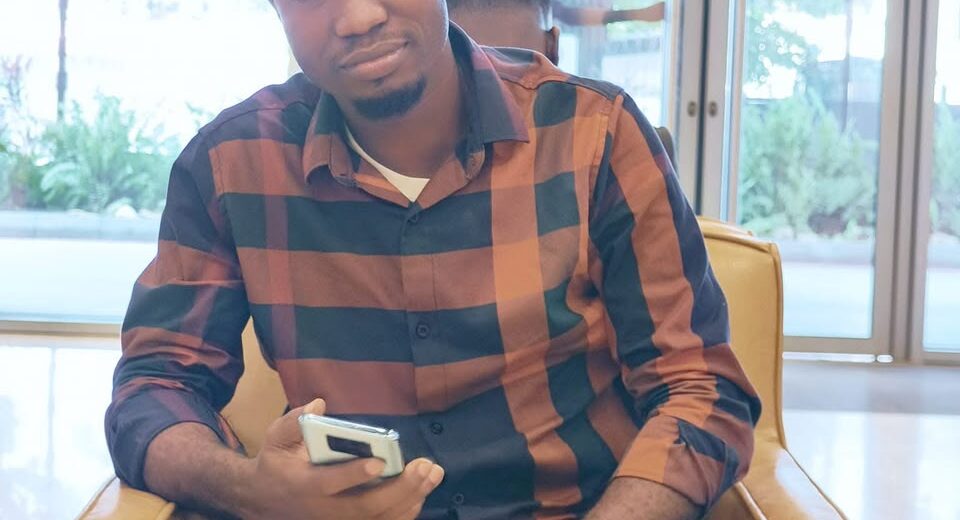
The Rising Watchlist has, for most of 2026, tracked the people the industry already knows how to talk about — the directors carrying films to festivals, the actors whose faces sell tickets, the producers assembling the deals. This week it turns somewhere the trade press, this one included, rarely looks: the art department. Samuel Udeh is an art director and production designer, which means his job is to build the physical world a story happens inside and then make you forget it was built at all. It is one of the least discussed crafts in African screen production, and as Nigerian cinema reaches for more ambitious worlds, it is quietly becoming one of the most important.
Udeh belongs on this list not because his name is familiar — it is not, and that is partly the point — but because his trajectory maps onto something RollCallAfrica has argued all year: that the next stage of Nigerian cinema’s growth depends on the crafts behind the camera as much as the talent in front of it. A film industry can only build the historical epics, the period dramas, and the prestige productions it now aspires to if it has the art directors who can construct those worlds convincingly. Udeh is one of the practitioners doing that work, and the watchlist exists to name the people building the industry’s future before that future arrives.
The Work
Udeh’s clearest calling card is White and Black, on which he served as Art Director — establishing the film’s visual language, its colour scheme, and its early costume direction, and holding artistic continuity across the wardrobe and production design departments. That film was nominated for Achievement in Costume Design at the 2024 Africa Movie Academy Awards, and the coherence of a film’s visual world is precisely the kind of foundation that a costume nomination rests on. He carried the same defining role on the feature When the Poor Smile, again setting the visual language from the ground up.
His wider filmography places him within the art department across a range of Nigerian productions — including the historical feature Out of Breath, which won Achievement in Production Design at the 2024 AMAA and closed that year’s Africa International Film Festival, and the Ojukwu and Living in Abuja series, where the work was continuity and set-property management. He has also worked as Art Director and Standby Art Director across numerous narrative shorts and independent projects — the lean, fast, under-resourced environments where an art director learns to build a convincing world out of almost nothing, which is the truest test of the craft.
Why the Craft Deserves the Watchlist
Here is the argument for putting an art director on a list usually reserved for directors and actors. Production design is measured by its own invisibility. When a period film convinces you that you are looking at a real past, you credit the director’s vision; when it feels cheap, you blame the budget. Rarely does anyone look at the art department, which is where authenticity is actually manufactured — the dressed set, the period-accurate prop, the continuity held shot to shot so the world never flickers. The better the work, the less you notice it, which means the people most responsible for whether a film is believable are structurally the least likely to be named.
That invisibility has a cost the industry is beginning to feel. The films winning at the AMAAs and the AMVCAs, the historical epics the industry is betting its prestige on, the period stories reaching international festivals — these live or die on whether their worlds hold together. A contemporary romance can be shot in a real apartment. A historical epic has to be built, and every anachronism is a puncture in the audience’s belief. As Nigerian cinema grows more ambitious about the pasts and the worlds it puts on screen, the art directors who can construct those worlds convincingly move from background labour to essential infrastructure. Naming them is overdue.
The Marketing Grounding

There is a detail in Udeh’s background that sharpens the case rather than diluting it. Before establishing himself in film, he led experiential-marketing and brand-activation work for TECNO Mobile, including the brand’s presence around Big Brother Naija in 2021 — coordinating large-scale activations tied to one of the most-watched entertainment platforms on the continent, working alongside ambassadors including Fireboy DML, Tiwa Savage, and the season’s eventual winner, Whitemoney. The discipline of experiential marketing — building a physical brand world, executing it flawlessly under a live deadline, holding a coherent aesthetic across a national campaign — maps directly onto the realities of running a film art department, where ambitious design has to be delivered on schedule and within budget. It is the same instinct in two arenas: construct an environment considered enough that people simply believe in it.
What We’re Watching For
Udeh describes the art department as “the physical soul of a story,” and the phrase is a fair statement of intent for a craftsman rather than a self-promoter. What the Rising Watchlist will track from here is whether he moves from art director and standby roles into full production designer credits on features with the scale to test him — the historical or period productions where the art department carries the film. The talent and the discipline are evident. The opportunity is the variable, and in an industry where the crafts behind the camera are chronically under-resourced and under-credited, opportunity is exactly what determines whether a promising art director becomes a defining production designer.
He says he is open to new feature, television, and international collaborations. On the evidence of the work, the industry would do well to give him the world-building jobs its growing ambitions require — and to start crediting the people who build the frame with the seriousness it already extends to the people inside it. That recalibration is what the Rising Watchlist is for. Samuel Udeh earns his place on it. Remember the name — even if, when the work is done right, you were never meant to notice it.
— Rotimi Fash. RollCallAfrica, Lagos. 13 August 2026. Profile based on Samuel Udeh’s professional filmography and public materials. Sources: Africa Movie Academy Awards (2024 record); production credits supplied by the subject.