I have been writing about East African cinema from Nairobi for twenty-five years. I attended the first Zanzibar International Film Festival in 2001 — when the idea of East African film being taken seriously by any international institution felt more like aspiration than plausibility. In 2025, a Kenyan documentary went to Sundance. In 2026, another Kenyan documentary went to Sundance. This is not a coincidence, and it is not luck, and the continent’s film institutions have not yet caught up with what it means.
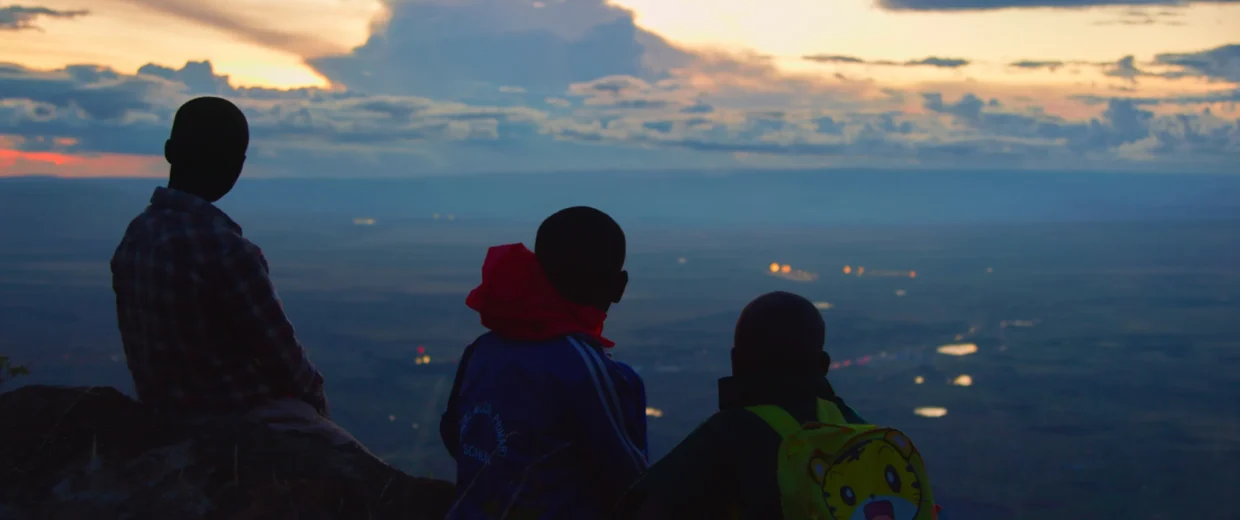
Kikuyu Land — directed by Kenyan journalist and filmmaker Bea Wangondu and Emmy Award winner Andrew H. Brown — premiered in the World Cinema Documentary Competition at the 2026 Sundance Film Festival. The film follows a Nairobi journalist who begins investigating land disputes involving local government and a multinational tea corporation and uncovers, in the process, secrets buried in her own family’s history. Personal investigation becomes political investigation becomes a film about what land actually means in Kenya — which is to say, a film about colonialism and its afterlife in the specific, practical, daily way that afterlife manifests in the bodies and disputes of living people.
The year before, How to Build a Library — about the extraordinary project of building a public library in Kilifi, coastal Kenya, by the community and for the community — competed in the same Sundance section. Two consecutive years. Two different directors. Two different subjects. Both made in Kenya, both about Kenya, both selected for the most competitive documentary section at the most commercially consequential film festival in the world.
The Pattern and What It Needs
The Sundance World Cinema Documentary Competition is not a charity programme for underrepresented territories. It has a specific curatorial bias: it selects films that are doing something formally and politically that distinguishes them from the international documentary mainstream. Films that have a specific intelligence about their subject, a specific rigour in their construction, and a specific relationship to the audience — not servile, not explanatory, not organised around the assumption that the viewer needs to be taught about the culture being depicted.
The Kenyan documentaries that are reaching Sundance share these qualities. They are not films made for foreign audiences to understand Kenya. They are films made by Kenyan filmmakers for audiences they consider capable of engagement, and the international festival circuit is responding to that quality.
What I want to examine is the infrastructure question — the question that is not being asked in the coverage of these selections, which tends to celebrate each Sundance appearance as a standalone achievement and move on.
How are these films being made? Who is financing them? What development support existed? What happens after the festival? Where do they screen in Kenya itself? Who is building the pipeline that would turn two consecutive Sundance appearances into a sustainable East African documentary tradition?
The Production Model and Its Limits
Kikuyu Land was developed through a combination of Kenyan journalistic infrastructure — Bea Wangondu’s investigative reporting background gave the film its initial entry point — and international documentary co-production support. Andrew H. Brown’s Emmy-winning background brought production resources and festival relationships. The film exists at the intersection of those two things: Kenyan story intelligence and international production capacity.
This model — Kenyan creative at the centre, international production partner providing resources — has produced the most internationally visible East African documentaries of the past decade. It is a viable model. It is also a model that does not build Kenyan production infrastructure from within, because the production capacity that makes the films festival-competitive arrives from outside.
Compare this to what is happening in West Africa. Dika Ofoma, whose short films are now at Venice, Rotterdam, and Clermont-Ferrand, has an entirely Nigerian production infrastructure behind his debut feature: producer Blessing Uzzi of Bluhouse Studios in Lagos, Nigerian cast, Nigerian financing anchored by Locarno Open Doors grants. The Esiri brothers just financed Clarissa entirely through African institutional capital — CANEX/Afreximbank and MBO Capital — and had NEON acquire it for global distribution before the premiere. The infrastructure around these films is Lagos-built. The films are Nigerian not just in their subject matter but in their production architecture.
East Africa does not have an equivalent structure. Kenya has talented filmmakers. It has Sundance appearances. It does not yet have the production infrastructure ecosystem that would allow those filmmakers to build sustained careers from within East Africa, with East African money, making films that remain East African in their production architecture rather than just their subject matter.
The Zanzibar Question
The Zanzibar International Film Festival — which I have attended every year since its first edition — is East Africa’s most significant film festival. It has been running for twenty-five years. In that time, it has showcased hundreds of East African films, provided a platform for the region’s filmmakers, and contributed to the cultural legitimacy of East African cinema. It has not produced an industrial infrastructure. It has not generated the kind of commercial ecosystem that AFRIFF is now building in Lagos, with government partnerships, film market programmes, and Goes to Cannes representation that puts five Nigerian projects in front of international buyers this May.
The question this raises is institutional rather than artistic. East African cinema is producing films of Sundance quality. The institutional infrastructure — the financing mechanisms, the development labs, the production ecosystems, the exhibition networks — has not kept pace with the creative output. Every Sundance appearance is built on the same mix of individual talent, international partnership, and the absence of domestic infrastructure. Each one is treated as a breakthrough rather than evidence of a gap that needs to be addressed.
What Should Happen
The Kenya Film Commission exists. The Tanzania Film Board exists. The institutions that should be building this infrastructure are present. What they have not done, at the level of ambition that the creative output demands, is made the sustained investment in production infrastructure — lab programmes, development funds, co-production frameworks with other African territories — that would turn the current creative moment into a durable industry.
The Nigerian model — whatever its commercial biases and structural limitations — demonstrates that institutional investment in production infrastructure produces compounding creative output. Lagos is not producing internationally competitive cinema because Nigerian filmmakers are more talented than Kenyan filmmakers. It is producing it because the ecosystem around those filmmakers creates the conditions in which talent compounds across a career rather than manifesting in isolated individual achievements.
READ ALSO: Egypt Makes More Television Than Any Other African Country. The Continent Barely Knows It.
Two Kenyan documentaries at Sundance in two consecutive years. RollCallAfrica is naming this as a creative moment and an institutional challenge simultaneously. The creative moment will continue regardless — the talent is there. The institutional challenge will not resolve itself. Someone in Nairobi, at the Zanzibar Film Festival, at the Kenya Film Commission, needs to read the Sundance selections as evidence that something needs to be built, not just celebrated.
Kikuyu Land is at Sundance 2026. How to Build a Library was at Sundance 2025. RollCallAfrica will be watching what East African institutions do with this window. We have been watching for twenty-five years. The window has not been this clear before.
Kikuyu Land (2026) · Directed by Bea Wangondu and Andrew H. Brown · Sundance Film Festival 2026, World Cinema Documentary Competition · Kenya
— Wanjiru Kamau. RollCallAfrica, May 2026. Sources: Sundance 2026 official selection, Showcase Africa, What Kept Me Up, Zanzibar International Film Festival archives.