
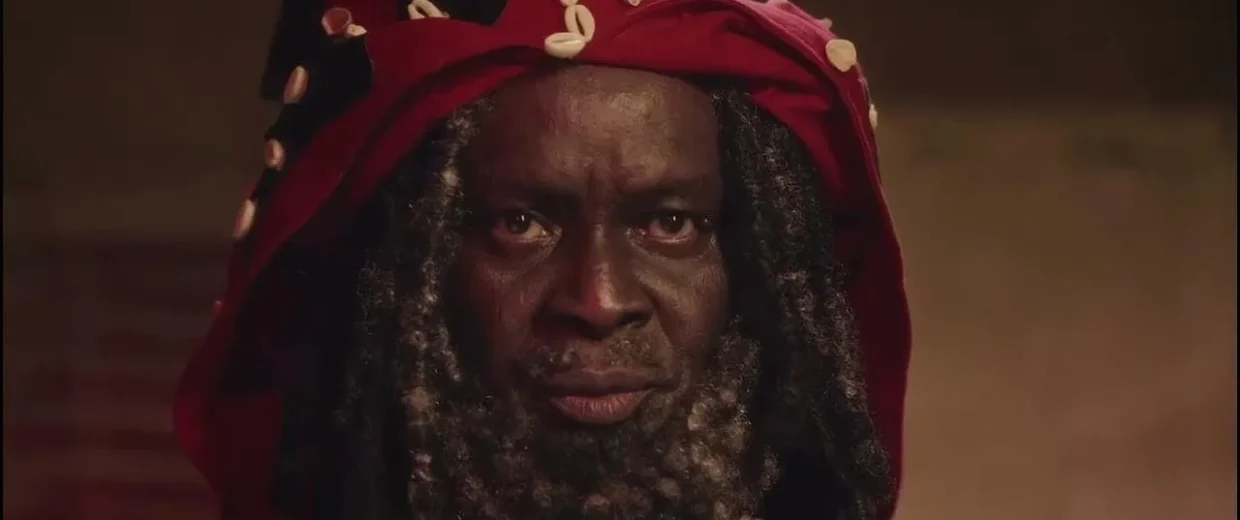
Agbara Nla: The Return arrives in Nigerian cinemas on October 1, thirty-three years after the original film became one of Mount Zion’s defining productions.
The date does more than provide a public holiday.
Producer Chris Odeh has said the Independence Day timing was initially selected to take advantage of the holiday period. The trailer’s language of deliverance also gives the date an additional thematic meaning for a film built around Christian spiritual warfare.
That combination of calendar, faith and nostalgia is a distribution strategy.
The original already did the expensive part: recognition
The first Agbara Nla was released in 1993, followed by an English-language version, The Ultimate Power, in 1994. Mike Bamiloye’s Isawuru became one of the most recognisable characters in Nigerian Christian film culture.
For the remake, Bamiloye returns to the role while his sons Damilola and Joshua Mike-Bamiloye lead the new production creatively. The project is produced by Chris Odeh and is being positioned as a contemporary cinematic version of the original story.
That gives the film an advantage many theatrical releases have to buy through marketing: decades of awareness.
The audience does not need to learn what Agbara Nla means before deciding whether the new film is relevant. The marketing job is instead to convince older viewers that the remake honours what they remember and younger viewers that the title belongs to them too.
Faith audiences operate like communities, not demographics
Faith-based film is often analysed as a genre. Commercially, its more useful characteristic is organisation.
Churches, ministries, Christian media networks, campus fellowships and religious creators can move information through existing communities. That lowers the cost of explaining why a title matters.
Mount Zion enters cinemas with decades of institutional trust among a specific audience. That does not guarantee ticket sales, but it changes customer acquisition.
A conventional producer may have to identify an audience from scratch. Agbara Nla already knows where much of its core audience gathers.
October 1 turns the opening into an event window
Public holidays matter because theatrical films compete for time as much as money. A holiday creates more available hours, more group outings and a stronger reason to schedule a communal activity.
The Independence Day date also gives the campaign a memorable anchor. Viewers are not being asked to remember an arbitrary Thursday. They are being asked to associate a familiar national date with the return of a familiar film.
The risk is that symbolism can be mistaken for demand. Nostalgia creates awareness, but the remake still has to satisfy viewers who can compare it with modern Nigerian theatrical production standards.
Damilola Mike-Bamiloye has said the new film went through extensive work to adapt the original for contemporary audiences and was produced specifically for the cinema experience.
The remake will test how transferable legacy really is
Nigerian entertainment has many recognised older titles, but not every property has been tested as a modern theatrical franchise.
Agbara Nla: The Return therefore has value beyond faith cinema. It can show whether a culturally embedded direct-to-video or television-era property can be converted into contemporary box-office demand.
If older viewers bring younger family members, the film will have converted memory into new audience acquisition. If attendance is concentrated mainly among people already emotionally attached to the original, the limits of nostalgia will become visible.
Either way, the release offers a useful business lesson.
A remake works best when the original is not merely known but connected to a community capable of acting on that recognition. Agbara Nla may have exactly that kind of legacy.