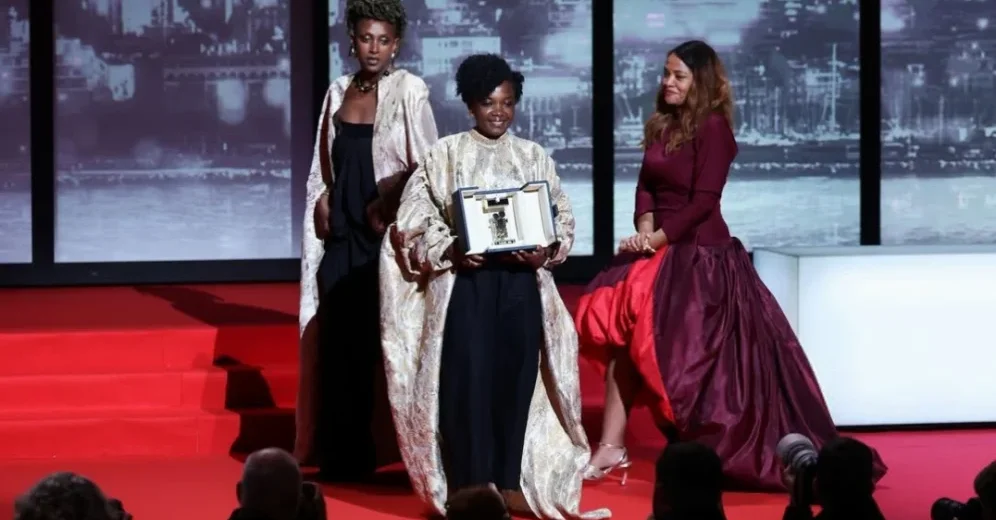
I told you in my last dispatch that I did not think the Caméra d’Or jury would leave Ben’Imana on the longlist. On Saturday night, May 23, at the closing ceremony of the 79th Cannes Film Festival, Marie-Clémentine Dusabejambo walked onto the stage of the Palais des Festivals and accepted the Caméra d’Or — the prize awarded to the best first feature film across every section of the entire festival.
Let me state plainly what this means. The Caméra d’Or is not a regional prize or a sidebar award. It is the festival’s recognition of the single best debut film among all the first features that screened at Cannes 2026 — in Competition, in Un Certain Regard, in the Directors’ Fortnight, in Critics’ Week. Dusabejambo’s Ben’Imana, the first film by a Rwandan director in the history of the festival, was judged the best of all of them. This is the most significant prize African cinema has won at Cannes since Abderrahmane Sissako won Best Director in Competition for Timbuktu in 2014 — and arguably, because the Caméra d’Or anoints the future rather than rewarding an established master, the most significant debut recognition African cinema has ever received here.
The win was, as one trade reporter present in the room described it, “a happy turnaround” — because the night before, the Un Certain Regard jury had given Ben’Imana nothing. The film had been blanked in its own section. And then, twenty-four hours later, the Caméra d’Or jury — which judges across all sections — reached past the Un Certain Regard jury’s verdict and named it the best debut at the entire festival. Ben’Imana also won the FIPRESCI Prize for Un Certain Regard, the international critics’ award. The critics and the Caméra d’Or jury saw what the section jury did not. On a night a Variety writer called one of the most Eurocentric in recent Cannes memory, that was the triumph African cinema refused to be denied.
Congo Boy and the Teenager Who Won Best Actor
And there was a second African victory, one that I have not stopped thinking about since it was announced. The Un Certain Regard jury gave its Best Actor prize to Bradley Fiomona Dembeasset — the eighteen-year-old who was found in a street casting in Bangui, who had never acted before, who plays the lead in Rafiki Fariala’s autobiographical Congo Boy, and who sings the film’s songs himself because Fariala taught him to sing them.
Think about the specific shape of this. Rafiki Fariala was shot at seventeen, left for dead, survived a year alone, and was saved by music. He made a film about that survival. He cast a teenager off the streets of Bangui to play the version of himself who lived through it. And that teenager — in his first performance, in his first film, at the most prestigious film festival in the world — won Best Actor in Un Certain Regard. The street casting won at Cannes. The boy who had never acted beat trained professionals from every major film industry on earth. That is not a feel-good anecdote. That is a jury recognising that the most truthful performance in the section came from someone who was not performing but inhabiting.
The Full African Record of Cannes 2026
For the record, here is what African cinema took from the 79th Cannes Film Festival: the Caméra d’Or (Ben’Imana, Rwanda) — best debut feature in the entire festival. Best Actor, Un Certain Regard (Bradley Fiomona Dembeasset, Congo Boy, CAR/DRC). The FIPRESCI Prize, Un Certain Regard (Ben’Imana). And a standing ovation at the Directors’ Fortnight for Clarissa (Nigeria/UK), which arrived with a NEON deal already signed.
The main Competition was, as it has been for twelve years, without an African director. Fjord, Cristian Mungiu’s Romanian drama, won the Palme d’Or — his second. The Grand Prix went to Andrei Zvyagintsev’s Minotaur. These are the films that will define the prestige conversation for the next year. None of them are African. The twelve-year absence of African films from the Competition continues.
But the Caméra d’Or is the prize that looks forward. It does not reward the cinema that already exists. It identifies the cinema that is coming. And in 2026, the cinema that is coming — the best of all the debuts, the future the festival chose to anoint — is Rwandan. It is a woman who learned filmmaking in Kigali two decades ago and refused to make her film in French. It is a story told in Kinyarwanda by a ninety-percent Rwandan crew. The future Cannes chose to point at this year speaks Kinyarwanda.
I have been coming to this festival for twenty-five years. I will remember this one.
— Amara Diallo, Cannes. RollCallAfrica, 24 May 2026.
Sources: Festival de Cannes official winners’ list (festival-cannes.com, 23 May 2026), Variety (23 May 2026 — Cannes awards), Deadline (23 May 2026 — full winners), The Cinema Group / Film Verdict (23 May 2026 — Un Certain Regard results).