There is a detail in the announcement of Clarissa‘s production financing that the international press reported without pausing on, and that the African trade press has not yet fully examined. The film — a contemporary reimagining of Virginia Woolf’s Mrs Dalloway, set in Lagos, shot entirely in Lagos and Delta State on 35mm film — was financed entirely by African-based institutions. CANEX Creations Inc., the intellectual property investment arm of Afreximbank’s Fund for Export Development in Africa. MBO Capital. Not a European co-production fund. Not the BFI. Not the CNC. African institutional money, for a film made in Africa, about Africa, with an African cast.
NEON — which distributed Parasite in North America, which acquired Past Lives before it became a global cultural conversation, which has built its identity as the international cinema distributor that bets on quality before the world tells it to — acquired US theatrical and international sales rights before Clarissa had screened publicly anywhere. The deal was negotiated by NEON’s Kate Gondwe, with UTA Independent Film Group representing the filmmakers. The Criterion Collection — which had already included Eyimofe, the Esiri brothers’ debut — released the Directors’ Fortnight lineup noting the film as one of the selection’s most anticipated.
All of this has been reported, in fragments, across the international trades. What has not been written is what it adds up to.
The Film
Clarissa is the Esiri brothers’ second feature. Their first — Eyimofe (This Is My Desire), shot in Lagos, premiered at the Berlinale in 2020, won five Africa Movie Academy Awards, was distributed in North America by Janus Films, and became the first Nigerian film added to the Criterion Collection. A specific kind of milestone: not a commercial record, not a festival prize, but a canonisation. The Criterion Collection exists to preserve the films that matter to the history of cinema. It said, of a film made in Lagos with no major international production infrastructure behind it, that it belongs in that history.
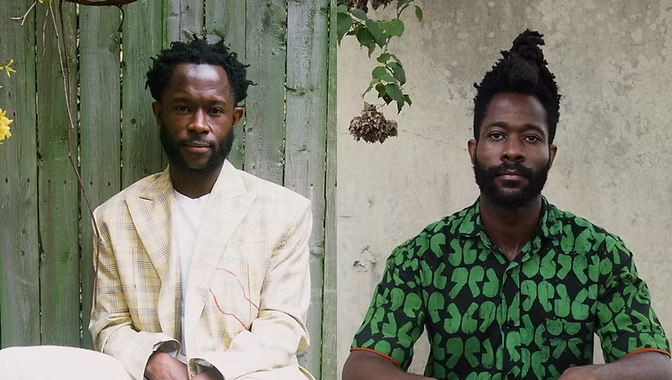
Six years later, the second film. Shot on 35mm — the choice that Chuko Esiri, who wrote and directed alongside his brother Arie, described in terms worth quoting precisely: “From the beginning, it was important to us that Clarissa be both rooted and resourced on the continent where it is set. Having African institutions back a film of this scale reflects a growing confidence that our stories can be produced from within. Clarissa is a story centred on time and memory, and in bringing it to life, we chose to shoot on 35mm in the hope it will first feel, then stand next to the great films of modern cinema.”
READ ALSO: Kenya Has Had Films at Sundance for Two Consecutive Years. Nobody Is Building the Infrastructure to Keep It Happening
The film follows Clarissa — a Lagos society woman preparing to host a party at her home — as old friends from her youth arrive and the evening becomes a reckoning with memory, past loves, hidden desires, and the life she has constructed versus the life she might have lived. The narrative weaves present-day encounters with childhood flashbacks to the Esiri brothers’ hometown in Abraka, Delta State. Virginia Woolf’s Mrs Dalloway — published in 1925, entered the public domain in 2021 — becomes, in their hands, a film about Lagos and the specific quality of longing that a city of that scale and complexity produces in the people who have built their lives inside it.
The Cast
Sophie Okonedo — Academy Award and Emmy Award nominee — leads. David Oyelowo is in the cast, making his second Cannes-associated film in a single cycle alongside Heist of Benin. Ayo Edebiri — Emmy winner, currently one of the most sought-after talents in global cinema — has a role that suggests the Esiri brothers are not using these names as commercial decoration. India Amarteifio (Bridgerton), Toheeb Jimoh (Ted Lasso), and Nikki Amuka-Bird (Knock at the Cabin) complete an ensemble that, on its own, would generate coverage in the global entertainment press regardless of the film’s quality.
The casting is a deliberate statement. These are British-Nigerian and Nigerian-British actors — people who exist in the same cultural space as the Esiri brothers, who carry Lagos and London and the diaspora experience in their bodies simultaneously. The choice to cast them is not a concession to the international market. It is a recognition that these are the actors whose specific biographies make sense in a film about a Lagos woman navigating memory and desire and the weight of the life she has built.
The Structural Story
The detail that the African trade press should be sitting with is the CANEX/Afreximbank financing — not because it is charming to see African money in African films, but because of what it operationally means for the industry going forward.
For as long as African art cinema has existed — since Sembène, since the first FESPACO, since the formation of the Francophone co-production culture that has financed most of the African films that appear at Cannes — the standard production financing model has involved European money. French CNC funds. German Berlinale co-production grants. Swiss development funds. Sundance Institute grants. The films are African. The money is European.
This is not an ideological complaint. It is a structural observation. The money shapes the films — in development timelines, in co-production obligations, in the international cultural market positioning that European funders naturally require because they are accountable to European cultural institutions for how their money is spent. The European co-production model has produced extraordinary African cinema. It has also produced an African cinema that is partly designed for European consumption, and the industry is sophisticated enough to know that and has been arguing about it for decades.
Clarissa was produced from within. African institutional capital — CANEX, MBO — financed a film at the scale that attracts NEON, that gets into the Directors’ Fortnight, that stars Sophie Okonedo and Ayo Edebiri. The Afreximbank statement said that the investment “underscores the growing capacity of African capital to support globally competitive film projects.” The actual argument is more radical: if African institutional capital can finance a film that NEON acquires for global distribution and the Directors’ Fortnight selects, then the structural dependency on European development money is not an inevitability. It is a default position that can be changed.
The Directors’ Fortnight Context
The Directors’ Fortnight is the Cannes sidebar that has historically been the home of the most formally ambitious, least commercially compromised films at the festival. Its alumni include Quentin Tarantino with Reservoir Dogs, Steven Soderbergh with sex, lies, and videotape, Spike Lee with She’s Gotta Have It, Wong Kar-wai with As Tears Go By. The Fortnight is where you go when your film cannot be contained by the festival’s main programming framework — when it is doing something that the main competition’s taste structure does not quite know how to accommodate.
The Esiri brothers are the only African filmmakers with a feature in the 2026 Fortnight selection. They are in a lineup alongside Radu Jude, Lisandro Alonso, Clio Barnard, and Quentin Dupieux — directors at the highest level of current world cinema. The Directors’ Fortnight did not select Clarissa out of a commitment to representation. It selected it because the film earned the selection.
Eyimofe was in the Criterion Collection. Clarissa is at the Directors’ Fortnight with NEON distribution. The trajectory is not incremental. It is accelerating.
What the Industry Should Do
Watch this premiere. Not because the Esiri brothers are Nigerian filmmakers making good — which they are — but because the commercial and creative architecture behind Clarissa represents the most coherent answer to the question that African cinema has been asking for sixty years: how do you make films of global significance from within the continent, without structuring your production around the requirements of the institutions that are funding it from outside?
The answer, in this case, is: shoot on 35mm in Lagos. Finance with African money. Cast with intention. Trust the form to do its work. Let NEON find you.
Clarissa screens in the Directors’ Fortnight at the 79th Cannes Film Festival, May 13–23, 2026. Directed by Arie and Chuko Esiri. Starring Sophie Okonedo, David Oyelowo, Ayo Edebiri, India Amarteifio, Toheeb Jimoh, and Nikki Amuka-Bird. Distributed worldwide by NEON.
— Kwame Asante. RollCallAfrica, May 2026. Sources: Deadline, Hollywood Reporter, Screen Daily, Criterion Collection, Afreximbank/CANEX press release (February 2026), What Kept Me Up.