
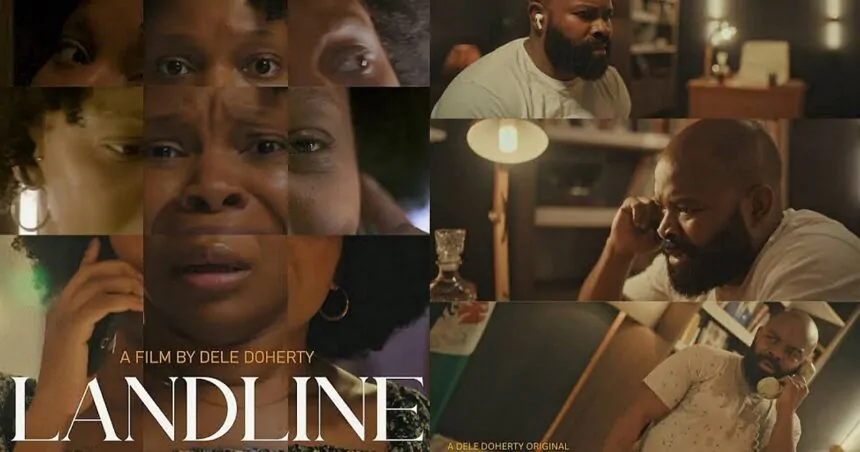
The premise of Landline is one that most Nigerian producers would have rejected on the first read: three characters stuck in a timeloop, shot in a single location, with a political argument about the EndSARS protests and the machinery of institutional corruption as the film’s central concern. No recognisable cast names in the lead roles. No marketable genre framework. Dele Doherty is the writer and director, and he is not a name the commercial system has been built around.
The film is on Prime Video. The Afrocritik review called Doherty’s approach “concise and metaphorical” and described the film’s political interrogation as skillful. What Kept Me Up said the screenplay’s “steadfastness” to its formal concept produced results. Culture Custodian positioned it within the context of Nollywood’s avant-garde tradition — specifically comparing it to Kenneth Gyang’s Confusion Na Wa as formal risk-taking that produces cinematic results. Doherty himself has cited Christopher Nolan’s Inception, Kubrick’s The Shining, and Scott Derrickson’s The Black Phone as reference points for specific scenes — which tells you he is working with a specific visual intelligence rather than general aspiration.
The timeloop structure allows Doherty to make the political argument the film is about without ever making it didactically. The characters in the loop are not in a loop by accident — they are in the specific loop that Nigeria has been in: the cycle of protest, suppression, apparent progress, and return to the same conditions that produced the protest. EndSARS happened in October 2020. The cycle it revealed — the SARS unit abolished, reconstituted under a different name, the same abuses resuming — is the precise timeloop the film is built around. You do not need the film to tell you this. The structure is the argument.
What the Formal Choice Does
The one-location constraint is not a budget limitation dressed up as aesthetic choice. It is what the film requires. The loop only works if the environment is fixed — the sameness of the space is the sameness of the conditions. Doherty shoots the space with the cinematography of Okwong Fadama (who also shot The Fire and The Moth — the same eye that made Egunjobi’s border town feel inhabited makes Doherty’s single location feel claustrophobic in the specific way the film needs). The performances have to carry the repetition without becoming repetitive themselves, and the three leads manage the distinction between “the same scene again” and “the same scene with different knowledge” — which is the formal challenge of every timeloop narrative and the one most of them fail.
The film is not perfect. Some political point-making lands with more weight than subtlety warrants. The ending resolves with slightly less formal ambition than the middle sections promise. But the overall achievement — a formally adventurous, politically specific, one-location Nigerian film that does not sacrifice its concept for accessibility — is more than enough to place Landline in the first rank of 2025 Nollywood output.
Its AMVCA Best Writing nomination confirms that the jury noticed. That the nomination is for writing rather than directing or picture reflects the same bias every experimental film faces in commercial award systems: the writing is visible in the conventional way, but the direction — which is what makes the writing work — is the harder thing to recognise. Landline‘s direction is what earns it this review.
Landline (2025) · Dir./Writer: Dele Doherty · Nigeria · Prime Video · Cinematography: Okwong Fadama · AMVCA 2026: Best Writing nomination