My Father’s Shadow opens on June 12, 1993. If you are Nigerian, you know what day that is before the film tells you: the day of the presidential election the military annulled, the day that became a wound in the country’s political memory that took twenty-five years and a renaming of a public holiday to begin closing. Akinola Davies Jr. does not use this day as background. He uses it as a condition — the political fact that surrounds and pressures everything in the film without ever being its subject. The film is not about the election. It is about a man and his two sons in Lagos on the day the election happened, and what the day does to all three of them by not being what they were told it would be.
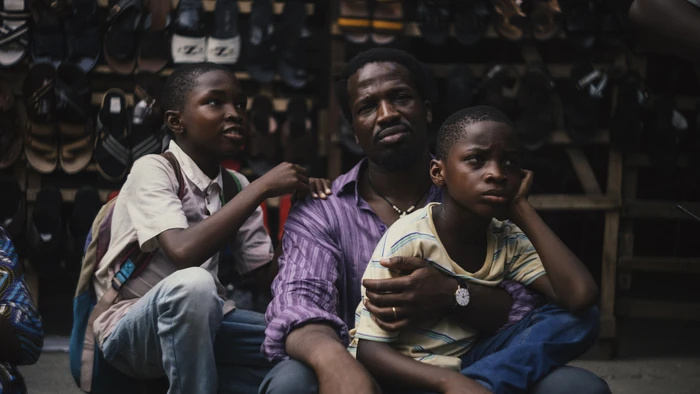
The man is named Sunday (Jermaine Edwards). He is separated from the boys’ mother. This is the day he has chosen to take them across Lagos to watch Nigeria’s World Cup qualifying match against Ivory Coast, and the film is the journey — the buses and the traffic and the city and the relationship between a father trying to hold his authority and his sons watching the attempt. Shot on 16mm by cinematographer Jermaine Edwards across real Lagos locations, the film has a grain and an intimacy that digital photography cannot reproduce: a documentary quality of being present in the city at the specific moment of this specific day, rather than a reconstruction of it.
The decision to shoot on 16mm is not aesthetic self-indulgence. It is the film’s argument in photochemical form. My Father’s Shadow wants you to feel like you are in Lagos in 1993, not watching Lagos in 1993 through the production design of a period film. The 16mm grain places you inside the reality rather than observing it from a safe contemporary distance. When the news of the annulment begins to reach the street around the family — not dramatically, not cinematically, but the way news actually reaches people in the middle of other things — you believe it is happening because the image looks like the kind of image that would have captured it.
The Formal Intelligence
Davies Jr. and his brother Wale Davies (who co-wrote the screenplay) have made a film about a man who cannot be what he wants to be for his sons on a day when the country also cannot be what it wants to be for its citizens. The parallel is never stated. It is structured. The father’s failed authority and the annulled election are the same kind of thing — a promise that was made and then retracted, leaving the people who believed in it to navigate what comes after. The film does not explain this to you. It places you in the day and trusts you to feel the resonance.
The performances work in the register the 16mm demands: present and specific rather than performed and emotional. Jermaine Edwards as Sunday carries the specific quality of a man who knows he has failed and is attempting to convert the day’s events into an experience of connection anyway. The boys — Kola Osungbesan and Ikenna Babalola — are not acting in the conventional sense. They are existing in the film, and the camera’s patience with their existence is what gives the film its emotional force.
What the Cannes Selection Confirmed
The film went to Un Certain Regard at the 2025 Cannes Film Festival. It won Best Director at the British Independent Film Awards. It took two Gotham Awards — Best Breakthrough Director and Best Lead Performance. It was the UK’s official submission for the 98th Academy Awards. It sits at 98% on Rotten Tomatoes. MUBI holds distribution for the UK, Ireland, North America, and Turkey.
The AMVCA 2026 gave it seven nominations including Best Movie and Best Director. The ceremony is Saturday. Whether it wins Best Movie at the AMVCA or not, the film’s position in the larger conversation about what Nigerian cinema can do and has done is already permanent. The Criterion Collection holds Eyimofe by the Esiri Brothers. MUBI holds My Father’s Shadow. The Nigerian film that operates without compromise at the level of international prestige cinema is not a theoretical category. It is populated.
My Father’s Shadow (2025) · Dir. Akinola Davies Jr. · Nigeria/UK · 16mm · 103 min · MUBI · Stars: Jermaine Edwards, Kola Osungbesan, Ikenna Babalola