
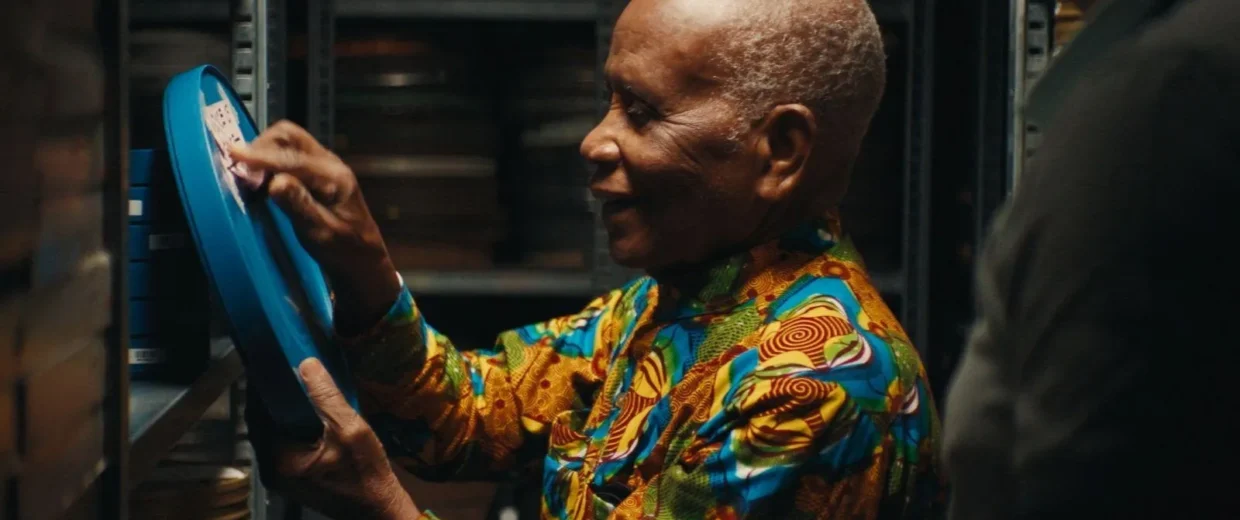
Every nation’s memory of its founding is built from images, and every image was made by someone. The Eyes of Ghana, from two-time Academy Award-winning documentarian Ben Proudfoot, is a film about that someone — Chris Hesse, the Ghanaian cameraman who filmed the independence era and the rise and fall of Kwame Nkrumah, and whose footage became the visual record through which Ghana remembers its own becoming. It is a documentary about the man behind the images, and it is a quietly profound meditation on who gets remembered and who does the remembering.
Chris Hesse was Nkrumah’s cameraman — present at the moments that made modern Ghana, holding the camera that captured the independence of the first sub-Saharan African nation to break free of colonial rule, the optimism of the Nkrumah era, and eventually the coup that ended it. His footage is Ghana’s memory of itself in its founding decade. And yet, like so many of the people who operate the cameras that make history visible, Hesse himself remained behind the image, uncredited in the popular memory his work created. Proudfoot’s film brings him forward.
What the Film Achieves
Proudfoot — whose short documentary work has twice won the Academy Award, built on a signature style of intimate, beautifully crafted portraits of remarkable individuals history overlooked — brings his full craft to Hesse’s story. The film is visually rich, drawing on Hesse’s own archival footage to tell both Ghana’s story and Hesse’s, weaving the national history and the personal one into a single narrative about the relationship between a man, a camera, and a nation. The archival material is extraordinary precisely because Hesse shot it, and the film’s use of it is both a historical document and a tribute to the eye that captured it.
The deeper achievement is thematic. The Eyes of Ghana is about the specific act of witnessing — about the person who stands behind the camera at the moments that become history, whose labour makes the collective memory possible and who is almost always forgotten in favour of the figures in front of the lens. By centring Hesse, Proudfoot makes an argument about whose contributions history records and whose it erases. The cameraman who filmed Nkrumah is as essential to Ghana’s memory as the events he filmed, and the film insists on that essentiality with grace and precision.
The Significance for African Cinema
There is a specific resonance in this film reaching audiences now, as African cinema builds its own institutions and its own record of itself. The Eyes of Ghana is, among other things, a film about the importance of the people who document — the cameramen, the archivists, the witnesses whose work becomes the raw material of a culture’s memory of itself. As African cinema grows, the question of who is preserving its record, who is behind the cameras capturing this moment of the continent’s screen history, becomes more urgent. Hesse’s story is a reminder that the documentation matters as much as the events, and that the documentarians deserve to be remembered alongside what they documented.
The film’s craft is impeccable, its subject essential, and its execution worthy of the Oscar-winning filmmaker behind it. If there is a limitation, it is the one inherent to the reverent portrait: the film loves its subject, and its love occasionally softens the harder questions it might have asked about the Nkrumah era and Hesse’s proximity to power. But this is a small reservation about a film that does something genuinely important — it honours the eye behind the image, and in doing so honours everyone whose uncredited labour becomes a nation’s memory.
RCA Score: 8.3 — Excellent
The Eyes of Ghana (2026) · Dir. Ben Proudfoot · Ghana / United States · Documentary · Subject: Chris Hesse.
— Kwame Asante. RollCallAfrica, Accra. 3 August 2026. Sources: Festival programme announcements (The Eyes of Ghana, 2026), Variety (February 2026 — African film festival lineup).