
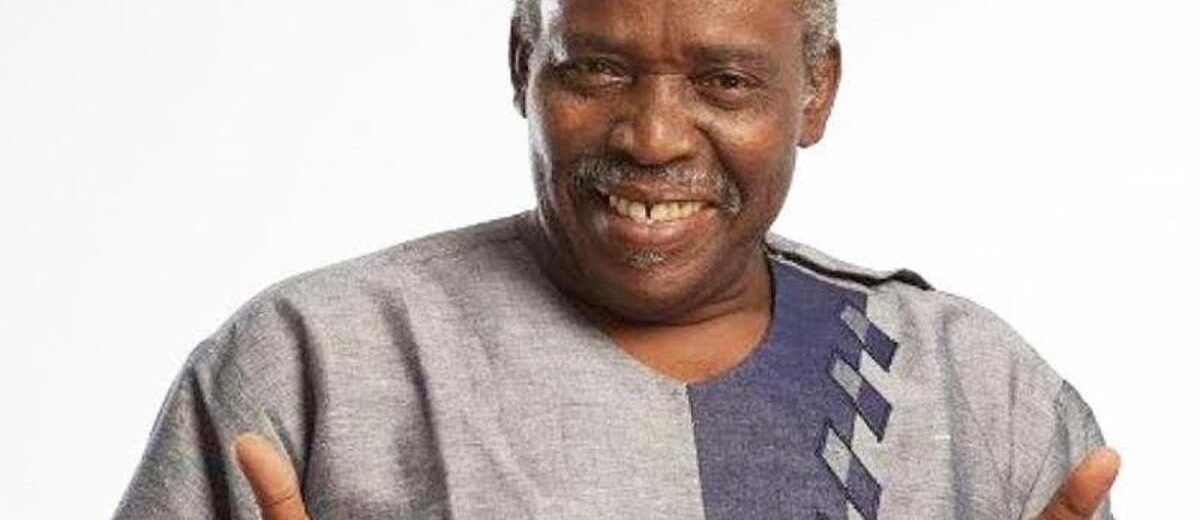
Olu Jacobs spent so much of his screen career playing men whose authority arrived before they spoke. Kings, chiefs, patriarchs and political elders became familiar territory. The voice was measured. The body remained still. The room usually adjusted itself around him.
But the most important authority Jacobs carried into Nigerian film was not fictional. It came from craft, preparation and a professional life that connected several eras of screen production.
Jacobs died on 16 September 2026 at the age of 84, according to an announcement by his son, Olusoji Jacobs. His death closes a career that ran through British repertory theatre and television, international cinema, Nigerian television, commercial Nollywood and performing-arts training.
That range matters because Jacobs was not simply present across those periods. He helped transfer professional habits from one to the next.
Before Nollywood had a name
Born Oludotun Baiyewu Jacobs in 1942, he trained at the Royal Academy of Dramatic Art in London and worked in British theatre and television during a period when African performers faced a narrow range of roles. His credits included appearances in The Goodies, Till Death Us Do Part, The Professionals and other British productions. He also appeared in international films including The Dogs of War, Baby: Secret of the Lost Legend and Roman Polanski’s Pirates.
These credits are often presented as proof that a Nigerian actor reached international screens. Their deeper importance is what Jacobs brought home: an understanding of rehearsal, voice, blocking, continuity and the discipline required to sustain a performance across stage, film and television.
When he returned to Nigeria, the industry he entered was changing. Television drama remained influential, theatre was still a major training ground and the video-film economy was beginning to create an entirely new production system. Jacobs moved through all three.
He made authority a craft
Nollywood’s early commercial years moved quickly. Productions were built around speed, star recognition and direct-to-video distribution. That system created an extraordinary volume of work, but it did not always leave room for formal preparation.
Jacobs became valuable because he could deliver gravity within those limits. He understood that authority was not the same thing as shouting. A pause could carry the scene. A change in posture could tell the audience who controlled the room. His diction was precise without making Nigerian characters sound imported.
This is why his royal and patriarchal roles travelled so widely across the continent. Audiences were not responding only to costume or status. They were watching an actor who had built a repeatable technique.
His 2007 Africa Movie Academy Award for Best Actor recognised a performance. His larger achievement was making professional control visible in an industry that was still defining its standards.
The bridge was institutional, not only symbolic
Jacobs is regularly described as a bridge between generations. That description becomes meaningful when it is connected to the institutions he helped build with Joke Silva.
The Lufodo Group extended their work beyond performance into production, distribution, venue management and training. The Lufodo Academy of Performing Arts was designed around practical instruction for stage, television and film. Its existence made a clear argument: talent is not weakened by training, and commercial screen industries need places where technique can be passed on deliberately.
That argument remains relevant. African film industries continue to celebrate visible talent while underinvesting in rehearsal infrastructure, continuing education and the institutions that preserve professional knowledge.
Jacobs and Silva treated performance as a profession before much of the surrounding industry had stable systems for professional development.
A career larger than a list of films
A conventional obituary can count Jacobs’ films, awards and international appearances. The more useful industry record asks what changed because he worked.
He gave Nigerian performers evidence that a career could move between countries and formats without abandoning cultural identity. He showed producers that experience could improve a fast production rather than slow it down. He demonstrated that an actor’s responsibility extended beyond appearing on screen to training, institution-building and protecting the dignity of the profession.
His marriage and working partnership with Joke Silva also offered the industry a rare example of two major performers building durable cultural infrastructure together. Their work survived changing distribution formats, changing audience habits and changing definitions of Nollywood.
The professional standard remains
Olu Jacobs belonged to a generation whose careers were built before Nigerian film became a global industry label. He lived long enough to see Nollywood move from cassettes and VCDs to cinemas, streaming services and international festivals.
The technology changed. The central demand of acting did not. The performer still has to understand the character, command the voice, listen to other actors and arrive prepared.
That is the inheritance Jacobs leaves behind.
RollCall Africa’s Film section follows the business and craft of African cinema, while our Interviews document the people building its next era.
Sources include the Jacobs family announcement, the Lufodo Academy of Performing Arts and publicly available British film and television records.