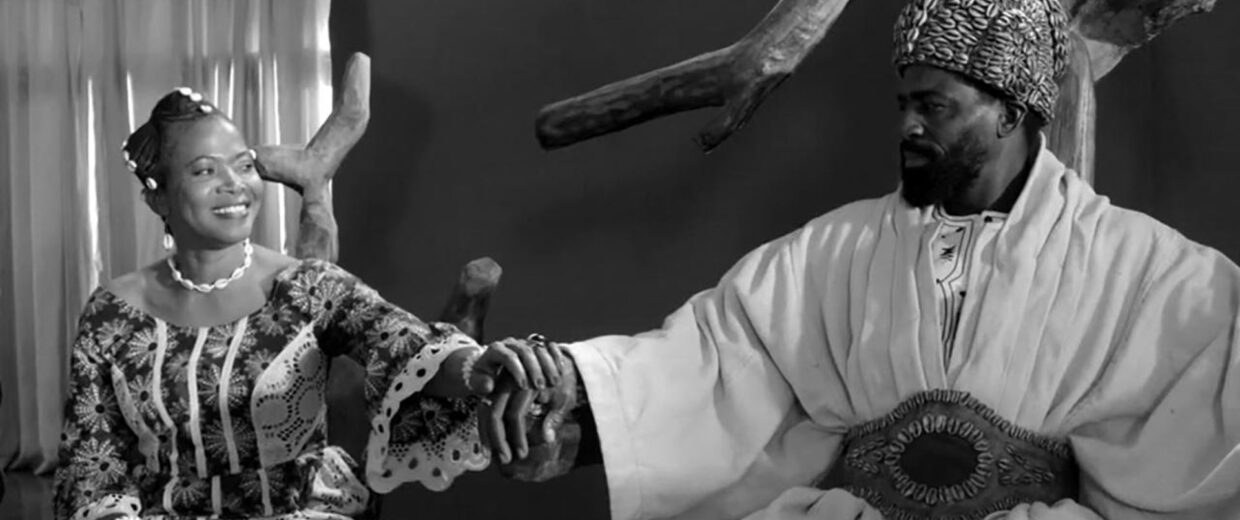
The first image of Katanga: The Dance of the Scorpions is a young man on a throne with a snake wound around his neck and a cowrie-studded helmet placed upon his head. Around him, older men. Outside the frame, a woman awakening from a dream that is not quite a dream. The image is black and white. It is ancient and it is outside time. And in that first minute, before anyone has spoken, before the soothsayer has appeared with her prophecy, before ambition has begun its work on a decent man — you know that Dani Kouyaté has made something that does not need to explain itself to anyone.
The film — a Macbeth adaptation set in a fictional African kingdom, shot entirely in Mooré, the language of Burkina Faso’s Mossi people — won the Étalon d’Or de Yennenga at FESPACO 2025. It was Burkina Faso’s first Golden Stallion in twenty-eight years, ending a drought that had begun to look like a structural problem and turned out to be a problem of patience: the continent was waiting for a film this good.
I was in Ouagadougou for the screening. The hall at Canal Olympia Ouaga 2000 understood what it was watching almost immediately. There is a specific quality to the silence of an audience that recognises itself in a film — not recognises its face or its landscape, but recognises its preoccupations, its arguments about power and loyalty and the way ambition corrupts the generous. That silence was in the room for two hours.
What Kouyaté Has Done with Shakespeare
The question every Shakespeare adaptation must answer is: why this story, in this place, at this time? Kouyaté’s answer is precise. He has said in interviews that he wanted the film to exist “outside time and space” — that the choice of black-and-white cinematography, by Marc de Backer, was made to give the work “an oneiric, timeless quality.” This decision was inspired by Kurosawa’s Throne of Blood (1957), which transposed Macbeth to feudal Japan with similar formal austerity. What Kouyaté has done is not simply follow that precedent. He has used the formal authority that black-and-white cinema carries — its distance from the merely contemporary, its seriousness — to insist that this story belongs to African political philosophy as much as it belongs to the English literary canon.
The adaptation is careful and bold simultaneously. Where Shakespeare gives us Lady Macbeth, unnamed and defined entirely by her relationship to her husband, Kouyaté gives us Pougnéré — a character with a name, a history, and a specific feminine intelligence that the text respects rather than merely uses. Katanga is not a feminist film in any declarative sense, but it is a film arranged as an ongoing social discourse about gender and power. The women in it — Pougnéré, Soubila, the Queen Mother, the soothsayer — are not supplements to the men’s tragedy. They are its architecture.
READ ALSO: Kaouther Ben Hania Makes the Unwatchable Necessary
In place of Shakespeare’s three witches, Kouyaté deploys a soothsayer and the scorpions of the title — instruments of prophecy that carry the film’s fatalistic logic with more elegance and cultural specificity than any translation of the original’s supernatural apparatus would have managed.
Mahamadi Nana as Katanga
The performance at the centre of this film is Mahamadi Nana’s Katanga — a man introduced as a military leader of honour, respected and capable, whose destruction begins the moment a prophecy places a crown in his imagination. Nana does not play Katanga as a villain. He plays him as a man for whom the distance between ambition and action closes gradually, then suddenly, and who cannot quite believe, at each stage, that he has become the thing he feared.
This is the hardest performance in Macbeth to sustain across a film’s full length — the maintenance of the audience’s sympathy for a man committing progressively worse acts — and Nana achieves it through an interiority that black-and-white cinematography serves beautifully. The camera can hold on his face in ways that colour photography, with its constant invitation to look at surfaces, does not always allow. What Nana does with those held shots is give us a man watching himself become what he will become and unable to stop the watching.
Hafissata Coulibaly as Pougnéré and Prosper Compaoré as the King are equally precise. The court dynamics in this film feel inhabited rather than staged — a result of the almost entirely Burkinabè cast working in their own language on territory their own culture has been thinking about, in its oral traditions and its griotic histories, for centuries before Shakespeare wrote a word.
The Budget and What It Proves
Kouyaté has been frank about making Katanga on a very low budget. He has described this as a liberation — the ability to focus on story, actors, and language rather than on special effects or spectacle. The result is a film that is visually striking precisely because it is not trying to impress with resources. Marc de Backer’s cinematography finds its beauty in composition and light — in the specific geometry of a man against an open sky, in the shadows cast by a palace that has seen too much, in the way a face lit from the side says more about a secret than any amount of dialogue.
The Étalon d’Or jury was right. The Public Prize — awarded by the FESPACO audience with an average score of 9.18 out of 10 — confirmed what the professional jury found. This is a film that earns its audiences on its own terms, without compromise, without concession to the international arthouse market’s expectations of what African cinema should look like. It looks like itself. It sounds like its own language. It thinks with its own philosophical tradition.
Thirty-four years after Idrissa Ouedraogo’s Tilai won the first Burkina Faso Golden Stallion, Dani Kouyaté — who spent his formation in the company of the continent’s great storytellers, including his father Sotigui Kouyaté of the Griot tradition — has made a film that earns its place in the same conversation.
It is essential cinema. That is not a category statement. It is a description.
Katanga: The Dance of the Scorpions (2025) · Dir. Dani Kouyaté · Mooré · 113 min · Burkina Faso · In limited international release via festival circuit