There is a question that hovers over every film made about an atrocity that is still happening: why this form? Why not a protest, a legal brief, a news report, a photograph? Why make a film?
Kaouther Ben Hania has answered this question three times in six years — with The Man Who Sold His Skin (2020), with Four Daughters (2023), and now with The Voice of Hind Rajab (2025). Each time, her answer is the same: because the film can make you feel what the news report cannot. Because the film places you inside the duration of suffering in a way that the photograph, which shows you a moment, cannot. Because the film is the form that gives time its full weight.
Hind Rajab was five years old. She was killed on January 29, 2024, by Israeli Defence Forces, trapped in a car with the corpses of her family members in Gaza City. She called the Palestine Red Crescent Society and spoke, by turns terrified and trusting, for a long time. Two paramedics who attempted to reach her were also killed. The IDF shot 355 bullets into the car.
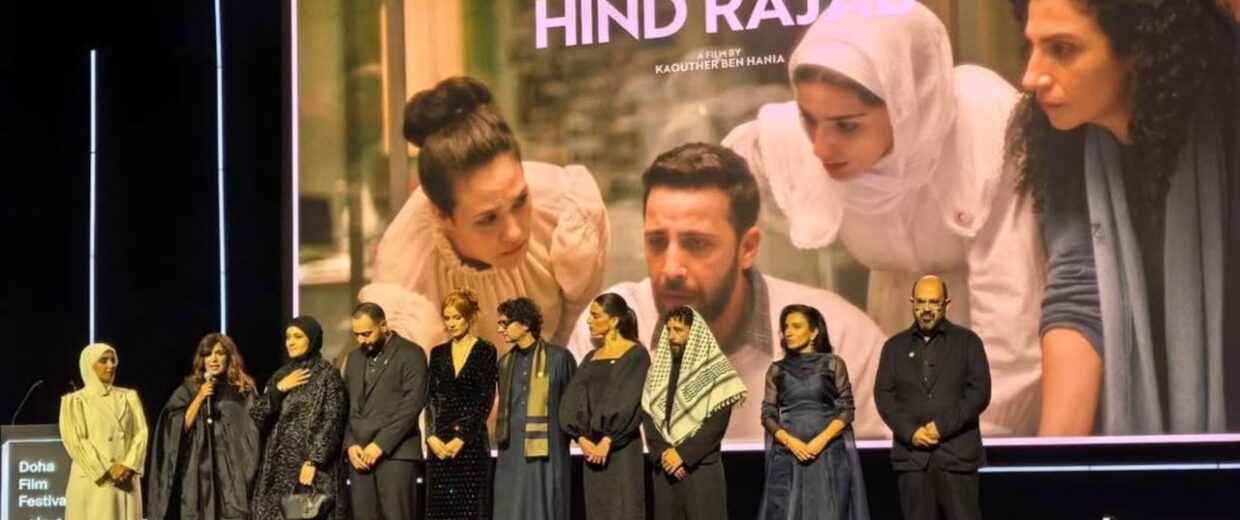
Ben Hania’s film uses the real recordings of Hind’s voice. She does not appear on screen — the director made this decision out of respect, with the support of Hind’s mother. What the film shows is the Red Crescent call centre: the volunteers receiving the call, managing the rescue attempt, navigating IDF checkpoints, listening. It confines itself almost entirely to this room. It ends the only way it can end.
The Formal Intelligence of the Film
The temptation in a film with this subject matter is to reach for scale — for cinematography that dramatises the horror, for editing that builds to catharsis, for music that tells the audience what to feel. Ben Hania refuses all of it. The call centre is small and institutional. The volunteers are ordinary people doing a technical job under impossible circumstances. The light is fluorescent. The camera is patient and close.
READ ALSO: Egypt Makes More Television Than Any Other African Country. The Continent Barely Knows It.
The restraint is not aesthetic modesty. It is an argument about where the horror actually lives. It lives in the ordinary — in the moment when a professional, trained to maintain composure, cannot maintain composure; in the length of a silence between transmissions; in the specific way a volunteer says the same calming words for the fourth time to a child who has been waiting for an hour. Ben Hania does not need to show you what happened in the car. She only needs to show you what happened in the room where people tried and failed to stop it.
The actors — led by Saja Kilani and Motaz Malhees — were not played Hind’s voice during rehearsals. They learned their lines in a normal rehearsal process. It was only during the actual shoot, in long takes, that the real recording was introduced into their headsets. Ben Hania has described what happened next: they were not performing. They were responding. The tears in this film are not manufactured. The camera knew this and stayed.
The Ethics Question
I will not pretend that questions of cinematic ethics are irrelevant here. They are not. A film that dramatises the final hours of a real child, using her real voice, will always attract them. Is Ben Hania converting suffering into cultural capital? Is she profiting — in prestige, in awards, in career advancement — from a death that happened to someone else?
These questions deserve to be held rather than dismissed. What I can say, having watched the film twice and having read Ben Hania’s accounts of its making, is that the work itself appears to have been made with a quality of attention to its subject that is the opposite of exploitation. Hind’s mother gave her support. The Palestinian Red Crescent workers were consulted. The decision not to show Hind — to give her voice its full presence while protecting her from the voyeurism of being represented — is evidence of a filmmaker who was thinking about the ethics of her choices at every stage.
At the Venice premiere, the audience stood for twenty-three minutes — a record for the festival, surpassing Pan’s Labyrinth’s 2006 Cannes ovation. That response was not for the spectacle. There is no spectacle. It was for the recognition that someone had found a way to make the unwatchable not merely watchable but necessary.
What It Means for African Cinema
Ben Hania is, with this film, her third consecutive Oscar nomination across six years — after The Man Who Sold His Skin (2020) and Four Daughters (2023). She is the first Arab woman to achieve three Oscar nominations in the Academy’s history. She is also, by the measure of sustained formal ambition and global recognition, one of the two or three most significant African filmmakers working anywhere in the world right now.
The African trade press, which tends to follow the theatrical commercial calendar, has not always served Tunisian and North African cinema with the coverage it deserves. The Voice of Hind Rajab demands the correction of that habit. This is a film made on this continent, by an African filmmaker, about a subject of global moral urgency, using a form of documentary-fiction hybrid that is more sophisticated than almost anything being made anywhere in world cinema. It won the Grand Jury Prize at Venice and six parallel awards. It is the only African film shortlisted for the 2026 Academy Award for Best International Feature Film.
The continent can claim it. The continent should.
The Voice of Hind Rajab (2025) · Dir. Kaouther Ben Hania · Arabic · 100 min · Tunisia-France · Hulu (USA) · Released theatrically in France Nov 2025