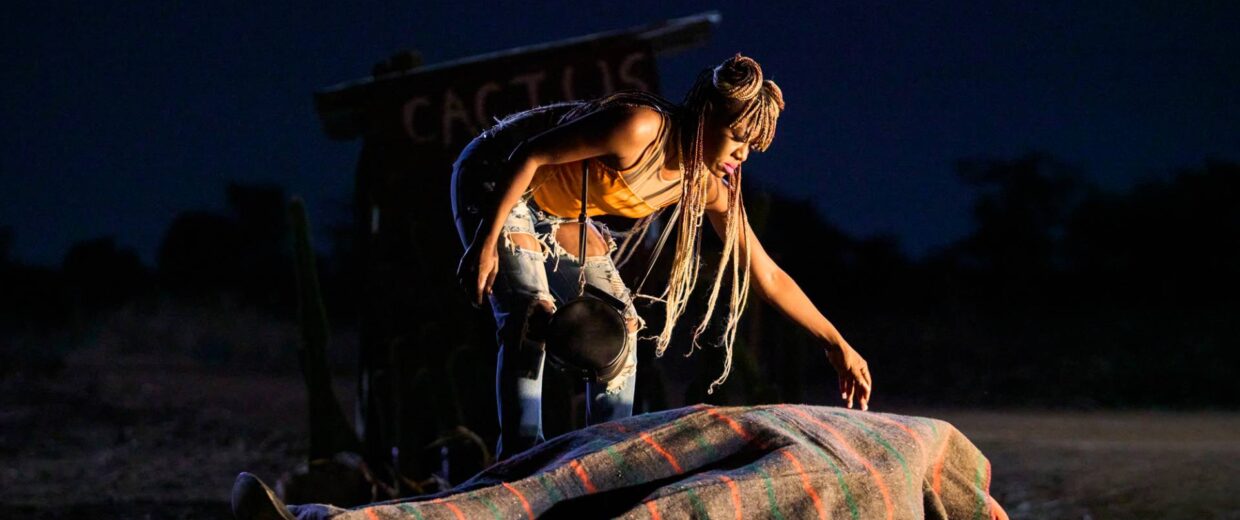
The first sight gag in On Becoming a Guinea Fowl is not comfortable. Shula, played by Susan Chardy, finds her uncle’s corpse sprawled on a Zambian backroad at 2am on her way home from a party. She is dressed for the party still — sequins, heels, the armour of a night out. The uncle is dead in the road with the specific undignified posture of the unexpected. Shula does not scream. She does not collapse. She stands and looks at him with an expression that is not grief and is not comedy and is precisely the thing that exists between them when what has happened is neither new enough to be shocking nor resolved enough to be mourned.
Rungano Nyoni won the Best Director award at Cannes 2024 for this film. It is her second feature — her debut, I Am Not a Witch (2017), was a formally controlled and darkly funny film about a young girl accused of witchcraft in Zambia that announced her as a filmmaker of exceptional singularity. Seven years on, On Becoming a Guinea Fowl confirms that the singularity is not a debut trick. It is a vision.
What the Film Is Actually About
Every review of this film has mentioned the funeral — the film is structured around the preparation and performance of a Zambian funeral following the uncle’s death — and the buried truths about sexual abuse and communal silence that the funeral’s extended duration forces to the surface. That description is accurate. It is also incomplete.
What On Becoming a Guinea Fowl is actually about is the emotional labour of being the person who manages. Shula is the cousin who calls everyone, coordinates the logistics, manages the family’s competing responses to the death, and does all of this while carrying — we understand gradually and then suddenly — her own specific history with the deceased uncle that makes the management of this death something other than grief.
The film watches women do this work. It watches them absorb what needs to be absorbed, defer what needs to be deferred, and perform the rituals that social coherence requires — not because these women are passive or complicit, but because they have been doing this since before they had language for it and will continue doing it after this particular funeral ends. The surrealist and magical realist elements that Nyoni folds into the fabric of this naturalistic drama — the women who appear and disappear, the animal imagery, the way time occasionally skips its obligations — are not stylistic exercises. They are the film’s argument about what happens to a woman’s interior life when the exterior demands constant management.
The Formal Achievement
Nyoni shoots in Zambia with an eye for the specific texture of this place — the compound, the relatives gathering, the food being prepared, the negotiations over property and grief that begin almost immediately after a death. The cinematography is not pretty. It is accurate. The film does not want you to find this environment picturesque.
What it wants you to find is the rhythm — the specific rhythm of how women move through the stages of a death in community. Nyoni paces the film with an unhurried confidence that lesser directors would mistake for slowness. Nothing in On Becoming a Guinea Fowl is slow. Everything is necessary. The scenes that seem to be about the funeral logistics are about the psychic logistics. The scenes that seem to be about family politics are about survival. You notice this in retrospect, which is when the film does its deepest work.
READ ALSO: Dani Kouyaté Gives Africa Its Own Macbeth
Susan Chardy’s performance as Shula is an exercise in containment. She is not underplaying. She is playing a woman who has learned, over a lifetime, that display is not available as a response to certain things — that the way to survive is to remain present, functional, and apparently unbroken while the interior does whatever it needs to do without witnesses. Chardy makes you see both registers simultaneously. That is extremely difficult. She does it in almost every scene.
The Bronze Stallion at FESPACO
The FESPACO jury’s Bronze Stallion recognises something that the Cannes Best Director award, for all its prestige, perhaps does not fully address: that this film is not merely formally accomplished but is formally necessary. It is building a film language — black comedy, surrealism, communal drama — specifically calibrated to the way certain experiences of womanhood on this continent are actually lived. Nyoni is not working from European models of how to tell African women’s stories. She is working from the inside.
What Nyoni is doing across two features is constructing a vocabulary. A Zambian filmmaker who studied in the UK, whose work has appeared at Cannes, TIFF, Venice, and FESPACO simultaneously, is making films that belong to all of those contexts without being owned by any of them. That is the condition of the best African cinema in 2025. On Becoming a Guinea Fowl is among its finest examples.
On Becoming a Guinea Fowl (2024) · Dir. Rungano Nyoni · Bemba / English · Approx. 95 min · Zambia-UK · International distribution via various territories