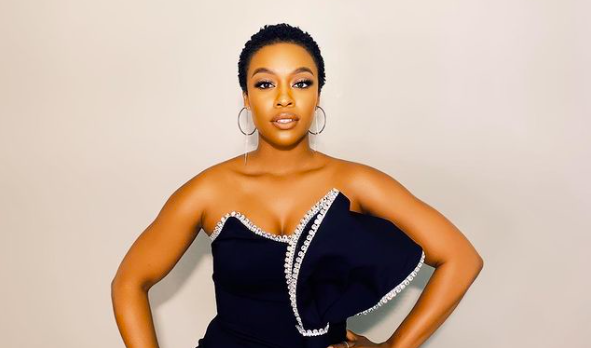
The story Nomzamo Mbatha has told about why she became an advocate — why the work on screen and the work off it have always, for her, been the same work — begins in Nairobi. She was fourteen. She had travelled to Kenya as a representative of Save the Children. It was her first time out of South Africa and into the larger continent she was theoretically part of but had not yet encountered in its specific, irreducible reality.
“It was the first time seeing kids from Somalia, from Sudan, from Cameroon, from Congo, from Kenya,” she told CNN in March 2026, “and I just thought, ‘Wow, this is who we are.'” She recalled the moment as the one that made the United Nations feel like a destination rather than an abstraction. “It sparked something inside of me and that’s when I knew; I’ve got to work for the United Nations one day.”
That dream came true in 2019, when she was appointed as a UNHCR Goodwill Ambassador — one of the few people on the continent who carries that designation through actual field work rather than as a ceremonial acknowledgement. By 2025, the TIME100 Next list had named her among the 116 exceptional people under 40 redefining leadership, describing her as someone who “embodies advocacy through action.” The citation noted what the film and television industry sometimes forgets to say plainly: that there are few people in the world who have “so fiercely carved lanes that both elevate African regalness in film and television and shine a light on the plight of refugees.”
Two things simultaneously. Not in sequence. Not as competing priorities. At the same time, all the time.
What Queen Nandi Gave Her
She has been playing Queen Nandi — the mother of Shaka Zulu, born around 1760, the woman who raised the preeminent Zulu leader under conditions of extreme poverty and social rejection — across the three seasons of Shaka iLembe. She is also the series’ executive producer. When she spoke to CNN in March 2026, the third and final season was in production. She described what the role had given her.
“Portraying her,” she said, “has been a privilege.” The sentence is simple. What it contains is not. Queen Nandi is not a supporting character in this series — she is its emotional and historical spine. The argument that Shaka iLembe makes about where the Zulu nation came from passes through her body, her decisions, her specific quality of endurance. Mbatha has spoken elsewhere about how playing a woman of this historical and cultural magnitude has given her what she described to CNN as “a new-found freedom” — the freedom of inhabiting a kind of power that African screen culture has historically not offered its leading women.
RollCallAfrica has followed Shaka iLembe from its first season, and we have noted consistently that the series’ significance extends beyond its box office records and SAFTA wins. It is a demonstration of what African screen culture can do with its own history when it is given the production resources, the creative ambition, and the institutional commitment that the project received from MultiChoice before the Canal+ acquisition changed the landscape. Mbatha’s executive producer credit is not ceremonial. She has been in the rooms where the creative and commercial decisions for this series were made. Her advocacy for the project’s ambition — its refusal to condescend to its subject matter or its audience — has been audible to anyone paying attention to how the series has been discussed in the South African industry.
The Question of What Comes After
The third season ends Shaka iLembe. It chronicles what Mbatha’s own press statement described as “a triumphant telling of Nguni history on an epic scale” — the final military campaigns, the founding of another nation, the arrival of the colonists at Port Natal. The series that began as the story of a woman managing impossible circumstances ends, as it began, with the question of what it costs to raise something world-altering under conditions that were designed to make it impossible.
That is, when you look at it plainly, also the story of the series itself. Shaka iLembe was made in South Africa, about South African history, in isiZulu, at a budget that required the belief of a company whose commercial logic was aligned with African cultural investment. The conditions that made it possible no longer fully exist. Mbatha knows this. The industry knows this. The question of what fills the space that this series is vacating — who will make the next African historical epic, at this scale, on these terms — is one that nobody has answered yet.
READ ALSO: Tshepiso Chikapa-Phiri On Building the Infrastructure She Was Waiting For
What Mbatha said at fourteen, in a room in Nairobi, when she saw who Africa actually was — “this is who we are” — is also the argument the series makes across three seasons of prestige television. The children she saw from Somalia and Sudan and Cameroon and Congo and Kenya were her people. The Queen she has been playing was built from the same conviction: that the continent’s history contains figures of regal authority, creative intelligence, and historical consequence who deserve the full treatment. Not the reduced version. The full thing.
RollCallAfrica will be watching whether the industry that produced Shaka iLembe finds the will to produce what comes after it.
— Wanjiru Kamau. RollCallAfrica, May 2026. Sources: Nomzamo Mbatha interview with CNN (March 2026), TIME100 Next 2025 citation, News24 (December 2025).