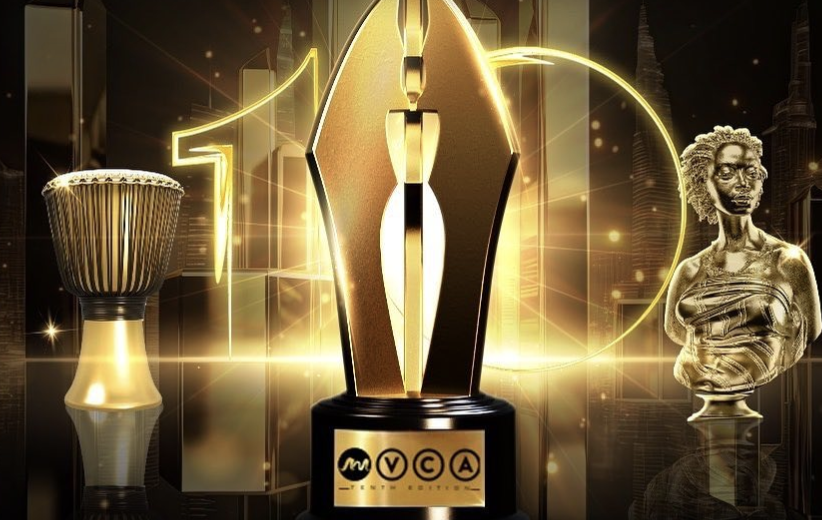
The 12th Africa Magic Viewers’ Choice Awards AMVCA ceremony takes place on Saturday, May 9, 2026 in Lagos, hosted by comedian Bovi Ugboma and South African actress and UNHCR Goodwill Ambassador Nomzamo Mbatha — a pairing that organisers have described as “a blend of wit, narrative, and global screen advocacy.” Veteran actress Joke Silva chairs the judging panel. Headline sponsor is premium spirits brand Don Julio. The nominations were announced live on March 29, hosted by AMVCA-winning actor Chimezie Imo. Thirty-two categories. Eighteen jury-decided. Eleven audience-voted. Three special recognition awards.
The frontrunners are not a surprise: Gingerrr and The Herd lead with nine nominations each across acting, directing, and technical categories. To Kill a Monkey follows with eight nominations. My Father’s Shadow has seven. The acting races are among the most competitive in the ceremony’s history — Lateef Adedimeji achieved a historic triple acting nomination, while Uzor Arukwe and Femi Branch each received double nods. Sola Sobowale, one of the most respected performers in the history of Nigerian screen culture, earned nominations in both lead and supporting categories.
All of this is the expected story. Here is the story that is not being told.
The Theatrical Signal
For the first time in the thirteen-year history of the Africa Magic Viewers’ Choice Awards, every film nominated in the Best Movie category had a theatrical run. Not one streaming-original. Not one straight-to-platform premiere. Every single title in the most commercially and culturally significant film category at Africa’s most watched awards ceremony was a film that opened in cinemas.
This is not a coincidence. It is an editorial position. The AMVCA jury — chaired by Joke Silva, one of the industry’s most respected senior voices — made a decision, implicitly or explicitly, that the films that deserved to be called the best of the year were the films that put themselves through the theatrical test. That they committed to the cinema audience before any streaming deal was offered. That they earned their numbers in public, in screens, with audiences who paid at the box office, before they arrived on any platform’s home page.
Gingerrr. The Herd. To Kill a Monkey. My Father’s Shadow. The Serpent’s Gift. 3 Cold Dishes. Behind the Scenes. Every one of them theatrical. The jury did not need to announce this position. They expressed it through the list they produced.
Why This Is Consequential
In 2022 and 2023, when streaming platforms — Netflix and Showmax primarily — were commissioning African originals at scale and the theatrical market was still recovering from the COVID closures, the AMVCA reflected a mixed landscape. Films that premiered directly on streaming platforms appeared in major categories alongside theatrical releases. The industry’s conversation during that period was actively uncertain about which model would ultimately define what African cinema was.
That uncertainty is now resolved, at least in the AMVCA’s reading. Showmax is closed. Netflix has contracted its African commissioning to Nigeria and South Africa. The theatrical market in West Africa broke records in 2025. Q1 2026 Nigerian admissions reached 752,136 — a six-year high. The jury’s nominations are a mirror: they reflect an industry that has decided, through commercial behaviour and through creative ambition, that cinema is the standard against which African film should be measured.
READ ALSO: The AMVCA Is Now a French Award.
The new regional categories — Best Indigenous Language Film (North Africa) and Best Indigenous Language Film (Central Africa) — are a separate but equally important development. For the first time, the AMVCA formally acknowledges that African screen culture does not begin and end in Lagos. North African and Central African productions are now eligible for category recognition alongside West, East, and Southern African content. Whether the industry infrastructure in those territories develops fast enough to consistently compete for those categories is the question the next several years will answer. The categories themselves are a declaration of continental intent.
Who Will Win
RollCallAfrica does not predict winners. We analyse the nominations and let the ceremony speak. What we can say is that the Best Movie race between Gingerrr and The Herd is the most substantive at this level in several years — two formally ambitious films, by two directors at genuinely different stages of their careers (Yemi Morafa with Gingerrr, Daniel Etim Effiong directing his debut with The Herd), each having earned their audiences the hard way. Emmanuel Igbekele, who received three Best Cinematography nominations for his work on three separate films in a single year, deserves specific attention from the industry regardless of what he wins or doesn’t.
The ceremony is on May 9. RollCallAfrica will publish the full winners list on the night.
— Kwame Asante. RollCallAfrica, May 2026. Sources: AMVCA 2026 nominations announcement (March 29–30, 2026), BellaNaija, Channels Television, Zikoko, wearehordes.com, ComicPanelWorld.