The story of how Cotton Queen was made is almost as compelling as the film itself. Suzannah Mirghani — Sudanese-Russian, a researcher and editor at Georgetown University in Qatar, a filmmaker whose 2020 short Al-Sit won the Canal+ Award at Clermont-Ferrand and sits on Netflix Middle East — spent years developing this feature. It was to be shot in Sudan, in the cotton-farming communities her script inhabits. Then the civil war broke out in 2023 and her country became unreachable.
She shot in Egypt instead. Twenty-five days. A cast of entirely non-professional actors, many of them Sudanese in displacement. A crew that would finish a long shooting day, step off the set, and realise they were still in Egypt, not Sudan, and take the bus home in tears. Mirghani has said the displacement was felt in the work — that the crew’s longing for home gave the film’s images of Sudanese village life a quality of tenderness that comes from people who cannot go back to the thing they are recreating.
That tenderness is legible on screen. Cotton Queen is not a film that looks at Sudanese village life from the outside with the slightly patronising care that often characterises films made about rural African communities for international festival audiences. It looks at it from inside — from the specific vantage point of a community with a particular history, a particular set of preoccupations, a particular sense of humour about its own contradictions — and trusts the audience to follow without being guided.
Nafisa and the World She Is Navigating
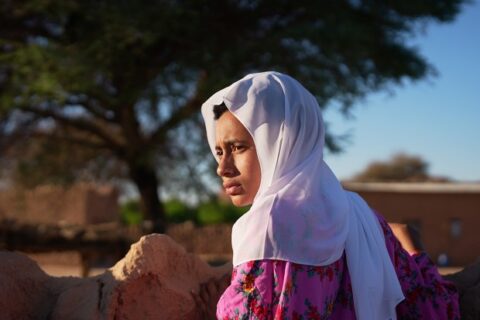
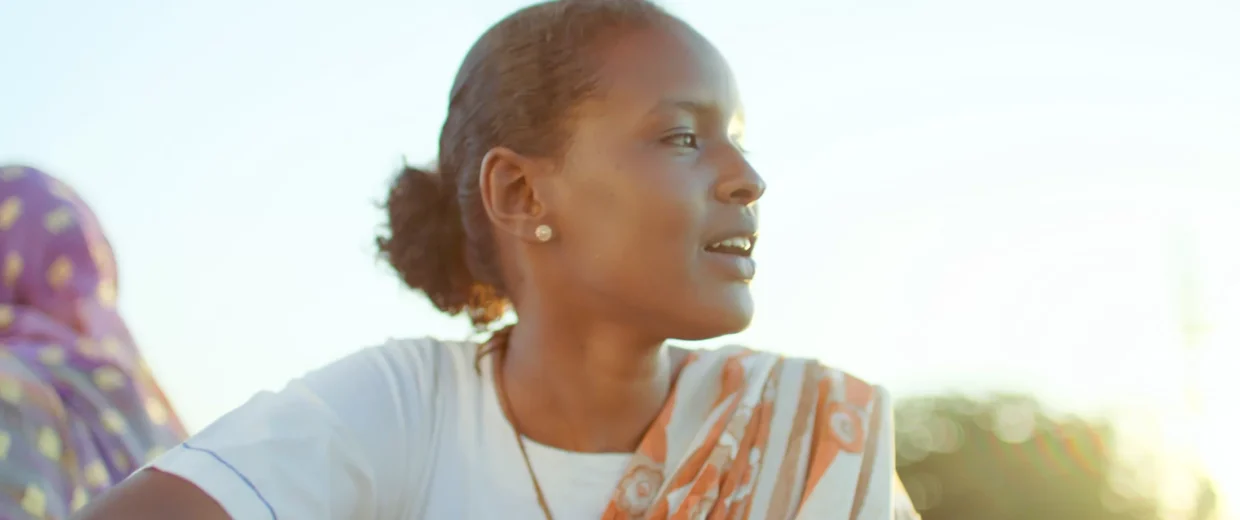
Mihad Murtada’s performance as Nafisa is the film’s great achievement. She is a non-professional actor — but she moves and listens and reacts with the confidence of someone who simply is the character she is playing, which is the best thing a non-professional performance can be. Nafisa works in the cotton fields run by her grandmother Al-Sit, dreams of marrying Babiker the onion farmer whom she genuinely likes, and finds herself drawn into a struggle she did not choose when an outside businessman arrives with proposals for development and genetically modified cotton seeds.
The film’s brilliance is in the layering of its power conflicts. Nafisa’s mother has plans for her. Al-Sit has plans for the village. The businessman Nadir has plans for the cotton. Mirghani’s screenplay — which she developed over three years, discovering its historical spine in the footnote of an academic paper about British colonial beauty contests held in English cotton mills — keeps all these competing interests in motion simultaneously without losing Nafisa at the centre. The girl is not a victim or a symbol. She is a person becoming.
READ ALSO: Egypt Makes More Television Than Any Other African Country. The Continent Barely Knows It.
Rabha Mohamed Mahmoud as Al-Sit is a revelation. The matriarch who has built this cotton empire on a founding myth — her resistance to the British colonisers — and who rules with a velvety authority that masks a steely control, is one of the most complex supporting characters in African cinema this year. Mahmoud is not a professional actor. You would not know it. There is a specific kind of screen presence that comes from people who have simply lived long enough in their own skin that the camera recognises something true in them — and Mahmoud has it completely.
The Film’s Limits
Honesty requires me to say that Cotton Queen has its strains. The middle section — as the various factions position themselves around the cotton question — can feel slightly schematic, the screenplay’s architectural intelligence occasionally showing its load-bearing beams. The film’s integration of magical realism into its otherwise naturalistic fabric is elegant but not always fully achieved; there are moments where the dreamlike and the documentary registers sit slightly uneasily rather than productively together.
These are the strains of a debut feature — of a filmmaker managing a great deal of material on limited resources under extraordinary personal and political pressure. That they do not undermine the work is a testament to the strength of what Mirghani has built at the film’s core: a portrait of a young woman becoming, shot in the specific colours and rhythms of a community whose complexity she has earned the right to depict.
The final shot — Nafisa standing in front of a fire she has set, the yellow-orange of flame against the cotton fields, her final line delivered with total certainty — is one of the most satisfying endings in recent African cinema. It earns its own symbolism completely.
Sudan’s civil war means that much of the human talent and creative infrastructure that might have grown around Mirghani’s debut cannot function right now. Cotton Queen was made under conditions of displacement and longing. When the war ends — and it will end — there is a Sudanese cinema waiting to be built. Mirghani has laid something toward its foundation.
Cotton Queen (2025) · Dir. Suzannah Mirghani · Arabic · 93 min · Sudan / Germany / France / Palestine / Egypt · International festival release