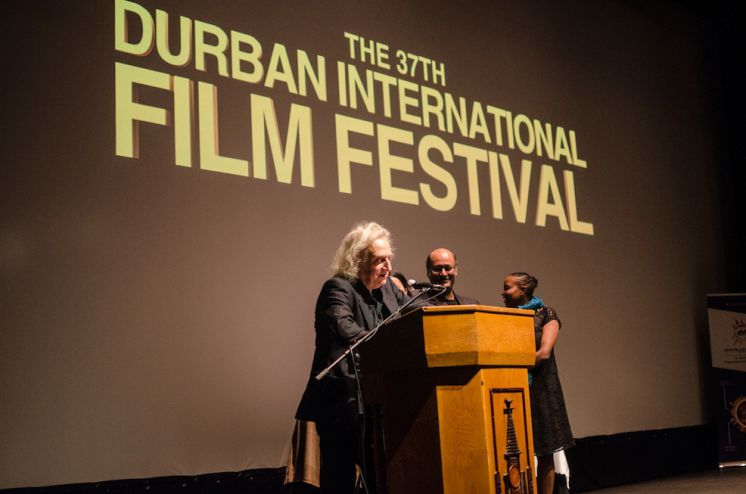
The Durban International Film Festival was founded in 1979 — seven years before Ouagadougou’s FESPACO held its first competitive edition, twelve years before the South African film industry began the structural transformation of the post-apartheid era. In its 47th year, running July 23 to August 2, 2026 at venues across Durban with the Durban FilmMart co-production forum operating July 24 to 27 at the Southern Sun Elangeni, it is the oldest film festival on the continent and one of the few African festivals with Oscar-qualifying status for its Best Documentary and Best Short Film prizes.
I have been covering DIFF for twenty-five years. I have seen it at its most abundant — packed programmes, strong international attention, a FilmMart humming with genuine co-production deals — and at its most pressured, when the industry it serves was in one of its periodic funding crises and the festival became less a celebration than a gathering of people needing to talk about what comes next.
This edition will be both simultaneously.
The Industry Context
The South African film industry enters DIFF 2026 in a complicated state. The DTIC rebate crisis — unpaid government claims dating back three years, an approval committee that failed to meet for more than a year — has been partially addressed through the working committee that Tshepiso Chikapa-Phiri and the Independent Producers Organisation secured after the Pretoria march in early 2025. But “partially addressed” is not the same as resolved, and the productions that were delayed, restructured, or cancelled during the crisis period will take years to fully account for in the industry’s output.
Showmax has closed. Canal+ is reorganising the MultiChoice infrastructure with a cost-saving mandate. Netflix’s South African commissioning, while active, is concentrated on formats — reality, thriller, returning series — that do not represent the formal ambition of the films that have historically anchored DIFF’s competition programme. The South African films that have been entering the Oscar race, winning BAFTAs, representing the country at international festivals — these are films made on the assumption of a functioning rebate system and a commissioning landscape with multiple serious players. Both of those conditions are currently less stable than they were three years ago.
Against all of that, DIFF arrives. Not as a solution to any of these problems, but as the festival it has always been: a gathering of the industry around the work, with the commercial infrastructure of the FilmMart alongside the curatorial commitment of over 250 screenings, township outreach programming, and the Talents Durban programme that has been developing South African film talent since 2008.
What to Watch
The full DIFF 2026 programme will be announced in June. Notifications to selected filmmakers go out May 1. What RollCallAfrica will be tracking through this edition is the FilmMart’s co-production deal flow — how many African-to-African co-productions are in active development, and whether the Lagos-Durban corridor that has been discussed at industry level for several years is producing tangible projects. It will also be tracking the African premiere programme: at DIFF 2025, the African premiere of My Father’s Shadow was one of the festival’s defining events, connecting the international festival circuit back to the continent. Whether equivalent moments exist at the 2026 edition will say something about the health of the pipeline.
The Oscar-qualifying status for Documentary and Short deserves emphasis, because it is one of the most practically useful features of the DIFF programme for African filmmakers and is consistently underreported. A Best Documentary or Best Short win at DIFF makes a film eligible for Academy Awards consideration — a pathway that does not require the cost and logistics of entering the US market independently. For East African, West African, and Southern African documentary filmmakers in particular, DIFF is not just a festival. It is infrastructure.
The Oldest Festival on the Continent
Forty-seven years is a long time to keep a film festival running in any territory. In South Africa, which has spent four decades navigating the transition from an apartheid-era cultural landscape to a post-apartheid creative economy with all of the financial instability, political turbulence, and structural complexity that transition involves, it is a remarkable institutional achievement. DIFF has survived the periods when it seemed like it might not. It has maintained its township outreach programming — bringing cinema to communities where cinemas do not exist — across the entire period of the festival’s existence, which means it has been making that argument, with consistent action, since 1979.
READ ALSO: Lagos Arrives at Cannes as a City, Not a Filmmaker
This year, that argument is more important than it has been in a long time. When the commercial infrastructure of African cinema is under pressure — when platforms close, when government rebates are unpaid, when the financing landscape contracts — the institutions that survive by doing the fundamental work of connecting films to audiences become more, not less, essential.
DIFF turns 47 in July. RollCallAfrica will be in Durban for the festival and the FilmMart. Full programme preview to follow in June.
— Lerato Dlamini. RollCallAfrica, May 2026. Sources: DIFF 2026 official website (ccadiff.ukzn.ac.za), FilmFreeway DIFF listing, Durban FilmMart Institute (durbanfilmmart.co.za), Wikipedia/DIFF history.