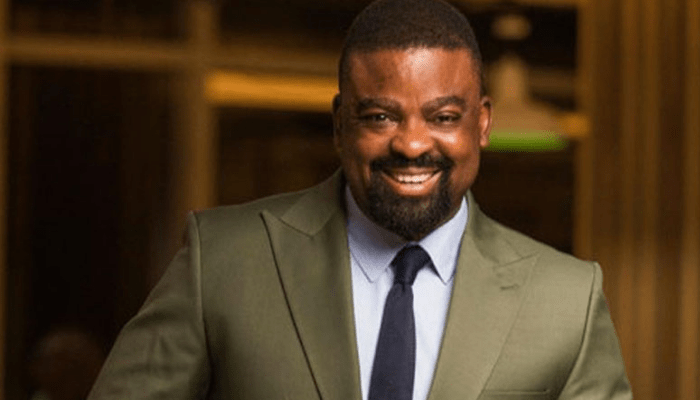
The video appeared on Kunle Afolayan’s Instagram page on the evening of February 10, 2026. It was calm. It was deliberate. And within twenty-four hours, it had become the most discussed statement in Nigerian film industry circles since Behind The Scenes crossed ₦2 billion.
Eleven days after Anikulapo: The Ghoul Awakens — the five-part continuation of his 2022 Yoruba epic — opened on Netflix to the kind of divided reaction that accompanies every ambitious serialised work in its early episodes, Kunle Afolayan addressed his critics directly. Not in a defensive crouch. Not in the language of wounded pride. In the language of someone who has been making a specific kind of film for a long time and has stopped explaining himself.
“Something that is very peculiar to the kind of films that we make,” he said in the video, which RollCallAfrica has reviewed in full. “We make films for the intellectual. We make films for people who can think. I don’t expect that everybody would like the film or understand the film. But I expect that the people that I am trying to appeal to would get it.”
He then did what confident people do when they make a contested claim: he produced the evidence. He cited Irapada — his 2009 Yoruba-language film that was dismissed on release and went on to win multiple international awards. He cited The Figurine, which weathered the same initial scepticism before securing its place as one of the formally significant works in Nollywood’s history. “At the end of the day, the film travelled,” he said. “It got awards. It was internationally recognised.” His point was not subtle. His track record is the argument, and the track record is not in dispute.
What He Actually Said — and What It Costs
RollCallAfrica was following the discourse closely when this statement landed, and what struck us was not the content — serious filmmakers have been saying versions of this forever — but the timing and the platform. Kunle Afolayan said this not in a festival Q&A, not in a profile interview for a foreign publication, but on his own Instagram page, in the middle of a Netflix release that was actively earning its audience. The commercial window was open. He chose that moment to close the door on viewers he was not making the work for.
That is a significant commercial decision dressed as an artistic position. It is also, depending on how you read it, either an act of integrity or an act of remarkable self-confidence — or both simultaneously, which is usually where the interesting filmmakers live.
When the feedback arrived from scholars, professors, and what he called deep thinkers who appreciated the series, Kunle Afolayan was specific about what that meant to him. “I have read from scholars, professors, deep thinkers; I have heard from them, and I appreciate them.” He was not being sycophantic to his most credentialled fans. He was mapping his actual audience and confirming that they were there, and that their presence validated the decision to make the thing for them in the first place.
The Industry Argument This Opened
The Afolayan statement cracked something open in the industry conversation that had been building for a while. Behind The Scenes — the film that crossed ₦2.76 billion and is now on Netflix — was made on a different premise entirely. Its marketing campaign was designed for mass accessibility. Its cast was chosen for commercial recognition. Its narrative was engineered for the broadest possible emotional legibility. It was the highest-grossing Nigerian film of all time. Afolayan did not make Behind The Scenes. He would not make Behind The Scenes.
The implicit question his statement raised — one the industry has not yet answered openly — is whether there is room, in the post-Showmax, Canal+-dominated, Netflix-concentrated streaming environment, for both kinds of work. For the film that is engineered for mass accessibility and the film that trusts a specific audience to meet it on its own terms. The commercial infrastructure is increasingly organised around the former. The artistic tradition that Afolayan belongs to — the lineage of Sembène, of Sissako, of Cissé, of Haroun — was built entirely on the latter.
RollCallAfrica revisited Afolayan’s Lagos Business of Film Summit appearance in early 2026, where he spoke candidly about cinema, YouTube, and the economics of filmmaking. The position was consistent: he is not anti-commercial, but he is anti-compromise of a specific kind. He left his Netflix multi-year partnership to return to theatrical with Recall in 2025 — his first major theatrical release since 2019’s Mokalik. He has launched KAPStream, his own YouTube channel, to make his back catalogue available to the audience that the streaming licensing cycle had taken away from him. He is building his own infrastructure, as most serious filmmakers eventually must.
READ ALSO: Kaouther Ben Hania On the Emergency That Made The Voice of Hind Rajab
“Those who understand literature,” he said in the February video, slipping briefly into Yoruba, “they already get it.” It was not arrogance dressed as humility. It was a filmmaker telling you, plainly, what he is and what he is not. In twenty-five years of watching this industry, RollCallAfrica has found that kind of clarity — however uncomfortable it makes the people it excludes — to be a more reliable predictor of lasting work than the films that try to be everything to everyone.
Whether The Ghoul Awakens justifies the position is a question the complete series will answer. What Afolayan’s February statement answers, with no ambiguity, is the question of whose answer he will be listening for.
— Kwame Asante. RollCallAfrica, May 2026. Source: Kunle Afolayan Instagram statement, February 10, 2026, as corroborated by Tribune Online, Legit.ng, and TVC News.