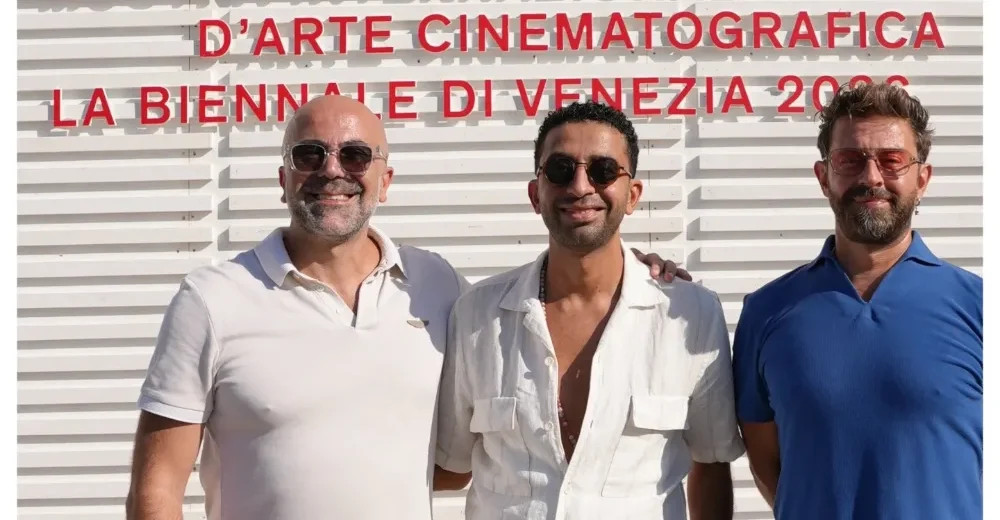
MAD Solutions and IRTH used the Venice Film Festival to announce something larger than a single co-production. The two Egyptian companies are building a partnership intended to develop, package and support Arabic-language films, television series and other entertainment formats.
On paper, the fit is clear. MAD Solutions has spent more than a decade building a network across distribution, marketing, talent representation and festival strategy. IRTH, founded and led by Egyptian writer and producer Haitham Dabbour, brings a development and production operation centred on original drama.
Together, they are trying to connect stages of the business that Arab filmmakers often have to navigate separately. The important question is not whether that pipeline can produce projects. It is whether the writers and producers who enter it will retain meaningful control over the rights once the projects begin moving.
A partnership built around the missing middle
Much of the conversation about film growth in the region focuses on two ends of the process. There is development support at one end and distribution at the other. The difficult space sits between them.
A promising script still needs packaging, financing, cast strategy, production partners, sales positioning and a realistic plan for reaching audiences. Many projects receive a workshop or a grant but do not acquire the commercial structure required to move into production.
The MAD Solutions and IRTH partnership is useful because it addresses that middle. The companies say they will work across films, series and other formats, including projects created for digital platforms. That wider brief gives them room to decide whether an idea is best served as a theatrical feature, a limited series or another form.
For creators, this can reduce fragmentation. A producer does not have to rebuild the same project for a new company at every stage. Market strategy can begin while the work is still being developed, not after the final cut is delivered.
MAD already controls several links in the chain
MAD Solutions is not entering the arrangement as a conventional production company. Its influence comes from operating across several parts of the Arab screen economy.
The group has worked in theatrical and non-theatrical distribution, international sales, publicity, talent management and festival positioning. Its expanding slate and regional relationships give it information about what buyers are looking for, which territories are responding to particular genres and how a project should be presented to international markets.
That intelligence can strengthen a film before production. It can also concentrate power. When one organisation participates in development, packaging, representation, marketing and distribution, the creator must understand which company is advising the project and which company is negotiating to own or exploit it.
Rights are where a pipeline becomes an industry
A healthy screen industry does more than produce films. It allows local creators and companies to build assets that remain valuable after the first release.
Copyright, remake rights, sequel rights, format rights, soundtrack rights and the ability to license a title across territories can generate value for years. If a writer or independent producer gives away too much of that position in exchange for development access, the project may succeed without building a durable business for its originator.
This is not an argument against integrated companies. Arab cinema needs organisations capable of combining capital, market knowledge and distribution. It is an argument for transparent deal structures.
Creators entering the new pipeline should know what happens if a project stalls, which rights revert, how backend participation is calculated, who approves changes and whether the company representing talent is also negotiating with another company inside the same corporate network.
Pan-Arab ambition still meets national realities
The phrase “Arab content” describes a connected cultural market, but the commercial reality remains divided. Egypt, Saudi Arabia, the Gulf, Lebanon, Morocco, Tunisia and other territories have different funding systems, censorship rules, theatrical capacity and audience habits.
A successful pipeline will have to treat that diversity as a production advantage rather than forcing every project towards one neutral regional identity. A Moroccan film does not need to sound Egyptian to travel. A Sudanese story should not have to remove its local texture to become legible to a Gulf buyer.
MAD’s distribution experience may help projects move between those markets. IRTH’s development role will matter most if it protects the specificity that made each project worth backing.
The real test comes after the announcement
The partnership was launched with the visibility of Venice, but its value will be measured through completed work. How many projects enter development? How many reach production? Who owns them? Which writers and producers graduate into stronger negotiating positions?
Arab cinema does not need another announcement that treats development as success. It needs a repeatable route from idea to audience, with creators participating in the long-term value created along the way.
MAD Solutions and IRTH may be capable of building that route. The quality of the contracts will matter as much as the quality of the slate.
RollCall Africa’s Film section follows African and Arab production businesses, while our Analysis desk examines the ownership decisions behind the headlines.
Sources include MAD Solutions, IRTH, Screen International, Variety, Deadline and BroadcastPro Middle East.