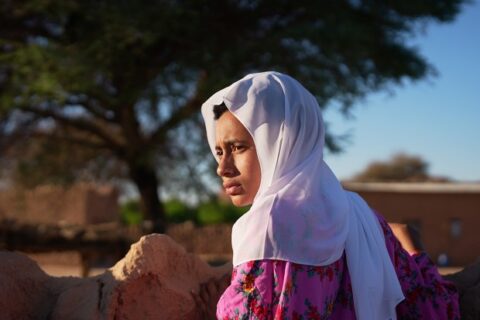
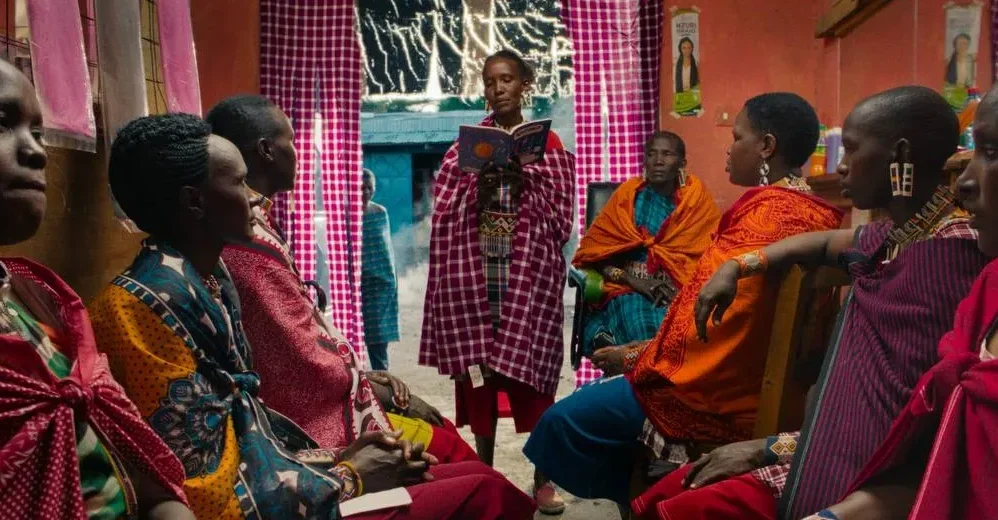
Star has lived in Sayit long enough for everyone to know her. That does not mean the village accepts that she belongs there.
Vincho Nchogu’s One Woman One Bra builds its central conflict around that difference. When residents of the rural Kenyan community are finally due to receive legal title to their land, 38-year-old Star discovers that recognition depends on kinship. She has no known parents, no husband and no children. The home she has occupied is suddenly treated as something she must prove she deserves.
The film could have turned this injustice into a solemn argument about women’s land rights. Instead, Nchogu uses humour, an increasingly desperate search for family and a ridiculous NGO campaign to expose the systems deciding whose identity counts.
The result is a sharp feature debut that understands belonging as both an emotional need and a legal asset.
A title deed becomes a verdict on a life
Sarah Karei plays Star as a woman accustomed to solving problems alone. She rides her motorcycle, works as a trader and moves between the village and town with an independence that should count in her favour. Inside the land-allocation process, it counts for almost nothing.
The village’s rules convert family structure into proof of legitimacy. A person connected to a recognised lineage can receive documentation. Star’s history is uncertain, so her claim becomes uncertain too.
Nchogu makes the issue concrete. Land is not discussed as an abstract policy debate. It is Star’s house, security and place in the community. Losing it would not only mean relocation. It would confirm what neighbours have implied for years: she is known, but not one of them.
The story gains momentum when Star sees a childhood photograph of herself in a book about nomadic people. A marked hand is visible beside her. She recognises the marking as one used by local women and begins to believe she has found a route back to her mother and the kinship evidence required to save her home.
The image that once turned her into an anonymous example of African life may now be the only document capable of protecting her.
The camera that took from Star may have to give something back
The photograph introduces the film’s most interesting argument. Star’s image has travelled further than she has. It exists in a published object, detached from her name, consent and material circumstances.
She was visible enough to be photographed, but not important enough to be identified.
This connects the land story to the long history of outsiders recording African communities. Photography and film can preserve evidence, but they can also remove people from context and convert them into symbols for distant audiences.
Star’s attempt to locate the foreign photographer is therefore not only a search for her origin. She is asking whether the person who benefited from her image has any obligation to the life that continued after the camera left.
Nchogu does not keep that moral problem comfortably outside the community. Star eventually reproduces a version of the same exploitation.
The bra campaign is funny because everyone understands the performance
When NGO workers misunderstand Star’s request for financial help, they become interested in an awareness campaign about women and bras. The cause is legible, fundable and easy to present as empowerment. Star needs money to buy her home, so she accepts the logic of the transaction.
With a younger woman named Nane, she creates the kind of suffering-centred video she believes foreign donors want to see. The comedy comes from the distance between the campaign’s language and the women’s actual priorities.
The film is not simply mocking charity or presenting every NGO worker as malicious. Its target is the economy of acceptable African problems. Support becomes available when local life can be repackaged into a simple story with a visible victim, an uncomplicated intervention and an outcome suitable for donor reports.
Star understands that system quickly because she has already been reduced to an image by it. Her decision to involve Nane complicates her position. She is a victim of extraction who is willing to extract from someone with less power when survival requires it.
That moral instability gives the film more life than a straightforward message drama. Star is not a symbol of perfect resilience. She is funny, strategic, lonely and capable of making a bad bargain.
Sarah Karei keeps the politics human
Karei’s performance holds the film together. Star’s confidence and isolation exist at the same time. She can move forcefully through the village and still feel the weight of being discussed as an outsider.
The character’s humour is especially important. It prevents the film from asking the audience to respect Star only because she suffers. She is allowed wit, stubbornness and social energy. The fight for land matters because a full person is at risk of losing it, not because the screenplay has arranged a lesson around her.
Nchogu’s pacing begins patiently, establishing Star’s ordinary rhythms before the title-deed dispute breaks them apart. That structural choice gives the disruption meaning. We first see the life that the legal process is about to destabilise.
Muhammad Atta Ahmed’s cinematography presents the Loita landscape with enough beauty to explain why Star refuses to leave. The images avoid treating the village as an undeveloped backdrop waiting for outside rescue. The setting is contemporary, economically active and visually specific.
That approach was reinforced by the production itself. According to Nchogu, roughly 70% of the cast and crew came from Nkosesia village, where the film was shot. The film uses Maa, Swahili and English.
A local story that does not translate itself into submission
One Woman One Bra emerged through Biennale College Cinema and premiered at Venice in 2025. It later won the Sutherland Award for Best First Feature at the BFI London Film Festival.
Its international path could have encouraged a film designed to explain every cultural detail to outsiders. Nchogu resists that pressure. The village is not simplified into tradition, and Star’s struggle is not presented as proof that African communities are uniquely hostile to women.
The conflict is recognisable far beyond Kenya: institutions often treat marriage, family and property as evidence of an adult woman’s legitimacy. What makes the film travel is not the removal of cultural specificity. It is the precision with which that specificity reveals a wider system.
The NGO satire occasionally risks becoming broader than the land story, but it ultimately serves the same argument. Whether Star is facing village authorities, a foreign photographer or charitable organisations, someone else controls the document, image or funding that can validate her life.
Her fight is to stop being material for other people’s systems and become the recognised owner of her own place.
One Woman One Bra arrives in Kenya after an international festival run. Its home release is the more important test. The film has already shown that Star’s story can travel. Now Kenyan audiences can decide what they recognise in the people who keep asking her to prove she belongs.