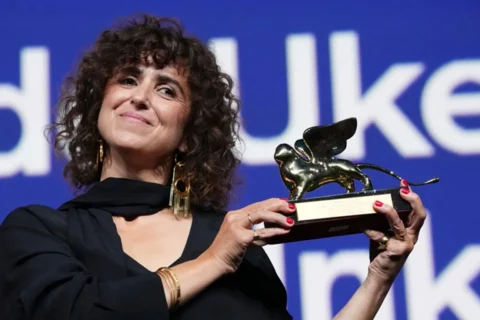
There is a particular kind of honesty in Rungano Nyoni’s press appearances that is unusual in the film industry, where the promotional circuit tends to smooth everything into gratitude and optimism. She does not do that. She says what she sees, including the things she would rather not see.
Asked in January 2025 by Deadline whether On Becoming a Guinea Fowl — her Cannes Best Director-winning Zambian drama — had screened in Zambia, the answer was simple and painful in equal measure. “Yeah, they showed it for one night during a festival.” One night. A film that won the highest individual prize in the Un Certain Regard section at Cannes 2024, produced by Element Pictures, distributed by A24, reviewed in the New York Times, the Guardian, the Washington Post — screened in the country it depicts, in the community its director moved back to, for one night.
Asked whether Zambian distributors had shown interest in a wider theatrical run, Nyoni did not hedge. “The distributors just aren’t interested,” she told Deadline. She did not elaborate. She did not need to.
The Country She Cannot Stop Writing About
What makes Nyoni’s repeated returns to Zambia — her first feature I Am Not a Witch (2017), now Guinea Fowl, and her physical return to Lusaka in 2024 — worth examining closely is the ambivalence she articulates about the place. She is not sentimentally attached to Zambia. She is structurally attached to it. The two things feel different and produce different creative results.
“I romanticise Zambia,” she told Deadline. “I still have this yearning for it. When you’re in the UK, you feel like you know everything and you can’t add anything to it cinematically.” She added something that gets at the specific creative logic of place: “I have a lot of half ideas that never go anywhere that are set in Cardiff. But somehow when I set the story in Zambia, I write more.” She also said, during the same interview, that she repeatedly tells herself while shooting in Zambia that she will definitely not do another film there. The conditions are harder. The financing is more difficult. The logistical weight of shooting on the continent with British money is a constant friction.
And then she writes another Zambian story. “I think it has to do with the fact that I romanticise Zambia,” she said again, with the slightly resigned tone of someone naming a condition they have stopped trying to cure.
The return in 2024 was not primarily creative. It was maternal. “I wanted my daughter to have a sense of her Zambianness,” she told Nkwazi Magazine in July 2025. “I wanted her to be rooted here before she experiences the rest of the world.” That sentence contains, in compressed form, the entire argument of both her feature films — the importance of being rooted in a specific place, a specific culture, a specific community, before the world reaches in and starts offering you its versions of who you are.
What the Film Is Made of
The subject matter of Guinea Fowl came from research she did in Zambia — from the specific, lived experiences of people who had survived sexual abuse within family structures, who were navigating the particular silence that communities maintain around perpetrators everyone knows. “What I found quite remarkable was how casual people are about sexual abuse,” she told CNN at Cannes in May 2024. “Sometimes everybody knows the perpetrator and sits at the same dinner table. How do you cope with that? How do you cope with somebody, that everybody knows they do that, and then ask them to pass the salt? It’s bizarre to me. How do you not get up and just set everything on fire?”
The grandmother figures in the film — the collective body of female elders who manage the funeral and the secrets simultaneously — came from her own family, from a grandmother called Shula whose storytelling tradition she credits explicitly for her formal instincts. “My grandmother used to tell many stories, or utushimi, including fairy tales,” she told Nkwazi Magazine. “They incorporate a lot of magic and music. I was trying to find a style that could be mine and not just copy anyone, so I looked to my grandmother.”
READ ALSO: Kaouther Ben Hania Makes the Unwatchable Necessary
The magical realism and the black comedy in her work — the thing that separates her films from every other film dealing with similar subject matter — are not formal exercises imported from European cinema. They are inherited from a specific storytelling tradition. “When you keep everything inside,” she said to Cineuropa at Cannes, “you go mad. Which is why all these strange, fantastical scenes made sense to me. That’s what happens: you literally drown.”
The Pressure She Won’t Accept Again
After I Am Not a Witch won her a BAFTA and established her international reputation, Rungano Nyoni has been candid in multiple interviews about what came next. The industry wanted her to be a specific kind of filmmaker — the kind that the diversity wave of the mid-2010s had created a market for. “Everyone had ideas about what kind of filmmaker I was supposed to be,” she told Nkwazi Magazine. “There were expectations from financiers, collaborators, critics, and I started making choices based on what others wanted, but I’ll never do that again.”
The seven years between her first and second films was partly this recovery — the process of unlearning other people’s ideas about who she was supposed to be and returning to the creative instinct that produced the first film. “I’d stopped writing,” she said. “I Am Not a Witch was hard to make, and I felt drained.”
What emerged from the seven years was a film about a woman who also could not speak about what she had experienced, whose silence was managed and maintained by a community structure that she could not escape. The gap between the filmmaker’s experience and the film’s subject is, in retrospect, more legible than it probably was while she was writing it.
The film screened in Zambia for one night. The story it told — of the casualties maintained by collective silence — played to an audience the size of a small gathering in a country of 20 million people. RollCallAfrica does not have an easy analysis of that gap. We only have the obligation to name it.
— Sade Bello. RollCallAfrica, May 2026. Sources: Rungano Nyoni interviews with Deadline (January 2025), CNN/Cannes (May 2024), Screen Daily (May 2024), Nkwazi Magazine (July 2025), Cineuropa (May 2024).