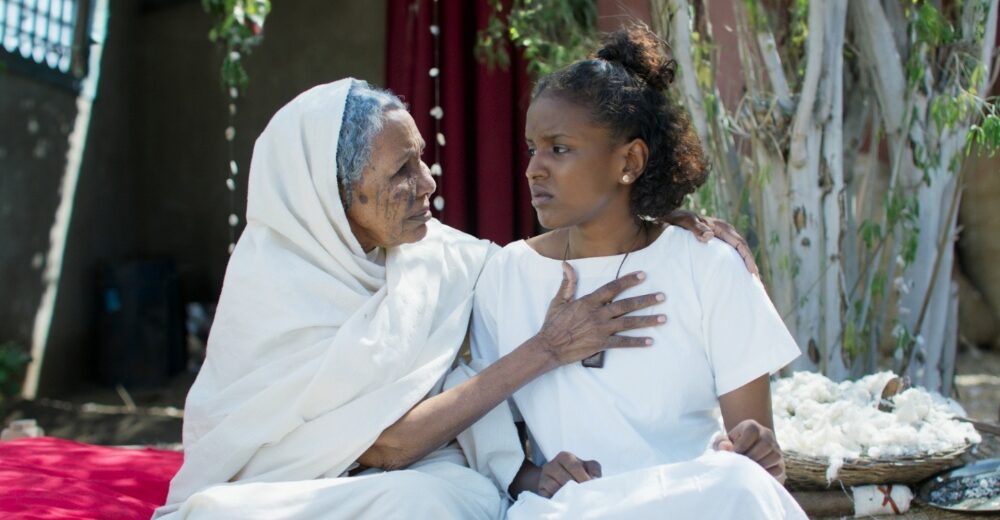
Suzannah Mirghani is Sudanese-Russian. Her 2020 short film Al-Sit won numerous prizes on the international festival circuit and established her as one of the most formally precise filmmakers to emerge from Sudan in a generation. Her debut feature, Cotton Queen, follows the woman known as the mystic first lady of the cotton fields — a figure whose story sits at the intersection of agricultural labour, spiritual authority, gender power, and colonial economic inheritance in Sudan’s Gezira scheme, one of the largest irrigation projects in the world, built by the British colonial administration to produce cotton for the Lancashire textile industry.
“Once you have cotton, you have all the dynamics around it,” Mirghani told OkayAfrica in an interview about the film. The sentence is both a production description and a historical argument. The cotton of the Gezira scheme produced and concentrated every form of power — economic, gendered, colonial, spiritual — that the film examines. A film about a woman who holds authority in that landscape is necessarily a film about all of those dynamics simultaneously.
Cotton Queen is releasing in cinemas across Egypt in May 2026.
Why the Egyptian Release Matters
From a North African and pan-continental distribution perspective, the Egyptian theatrical release of a Sudanese film is a rare and consequential event. Egyptian cinema — with the largest theatrical market in North Africa by volume and the most established distribution infrastructure — has historically been self-sufficient in a way that has made it resistant to importing content from other African territories. The Egyptian audience’s relationship with Sudanese culture is complicated: geographically adjacent, linguistically related through Arabic, but with a distinct cultural identity and a colonial economic history that does not produce simple solidarity.
A Sudanese film about cotton colonialism, by a Sudanese-Russian filmmaker whose short film won international prizes, releasing in Egyptian cinemas is a distribution event that the trade press has largely not registered. RollCallAfrica is registering it. If Cotton Queen performs in Egyptian cinemas — not at scale, necessarily, but with genuine critical reception and audience engagement — it demonstrates that the North African distribution network can carry serious continental African cinema beyond the programming of cultural institutes and film festivals. That demonstration has value far beyond this single film.
Sudan, Cinema, and This Moment
Sudan has been in a state of devastating civil war since April 2023. The conflict between the Sudanese Armed Forces and the Rapid Support Forces has produced one of the largest displacement crises in Africa. The cultural institutions that Sudanese artists relied on have been damaged or destroyed. The conditions for making films in Sudan are, at this moment, among the most difficult on the continent.
This makes Mirghani’s achievement — completing a feature film, securing Egyptian theatrical release, reaching the Cannes programming conversation — an act of cultural continuity rather than mere artistic ambition. She is carrying the story of the Sudanese cotton fields into cinemas in a year when Sudan itself is experiencing a different kind of catastrophic destruction. The film’s subject — colonialism’s long extraction from a specific landscape and the people who worked it — lands differently in May 2026 than it would have in any other year. The relevance is not symbolic. It is historical.
Cotton Queen (2026) · Dir./Writer: Suzannah Mirghani · Sudan/Russia · Releasing in Egyptian cinemas May 2026. Sources: OkayAfrica (May 2026). — Nadia El-Rashid. RollCallAfrica, May 2026.