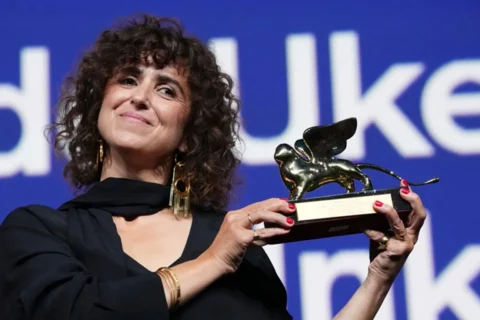
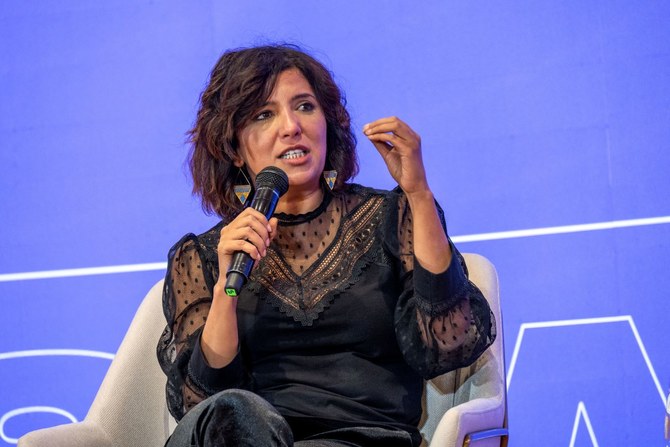
Kaouther Ben Hania has described the decision to make The Voice of Hind Rajab many times now — at Venice, at Toronto, at the Doha Film Festival, in the UK press circuit in January 2026, in the American awards campaign rooms where the film eventually made the Academy Awards shortlist. Each time, the account begins in the same place: a layover at Los Angeles International Airport, during the Oscar campaign for Four Daughters, a social media scroll, and a voice she could not unhear.
“I felt like she was asking me to rescue her,” the Tunisian director told the Associated Press the day before the Venice premiere in September 2025. She knew, as she said this, that the rational part of the statement required immediate qualification. “It’s not rational what I’m saying, because I knew the tragedy already happened.” But rationality was not the operating principle of that moment at LAX, or of the twelve months that followed it. Something else was operating. “I asked of myself, ‘What can I do,’ and I only know one thing: how to tell stories.”
She was supposed to be entering pre-production on a film she had been writing for ten years. That film was called Mimesis — a Tunisia-set drama about a woman investigating the origins of a cult, set in the 1990s. It had been developed carefully. It had financing in place. It had the kind of long institutional support behind it that serious European and African co-productions accumulate through years of festival labs and development funds. She put it down. “There was kind of an emergency that I was feeling,” she told Screen Daily in January 2026, “and I contaminated everybody.”
The Decision to Feel Rather Than Explain
The formal decision that defines The Voice of Hind Rajab — the decision to set the film entirely in a Red Crescent call centre, from the perspective of the volunteers, using Hind’s real voice — was not the only possible decision. Ben Hania’s background is in documentary. Her Oscar-nominated Four Daughters blurred the boundary between documentary and fiction with the specific intelligence of a filmmaker who is genuinely interested in what each form can and cannot do.
For this subject, the documentary approach was not adequate. Not because it had not been tried — detailed investigations by the Washington Post and Forensic Architecture had already produced rigorous accounts of what happened on January 29, 2024. “We are done with explaining,” she told Gold Derby in January 2026. “You have to feel.” The Al Jazeera documentary had been made. The forensic analysis had been done. The facts were not in dispute among the people who were paying attention. What had not been made was something that required you to sit in the duration of it — to experience the seventy minutes of that phone call not as documented fact but as shared time.
“The main idea was how to translate the impact of hearing Hind’s voice for the first time,” she told Screen Daily. “I thought that a documentary about an event in the past wouldn’t have the same emotional impact on the audience. I thought we are done with explaining — it’s time to feel, to be in the place of the other.”
The Urgency She Could Not Ignore
What is most striking in Ben Hania’s accounts of making this film — and RollCallAfrica has followed them closely across the full press circuit — is the way she frames the film’s relationship to the present tense. Not the past. The present. “While I was thinking about the movie, writing the movie, doing the movie, presenting the movie in Venice,” she told Gold Derby, “a Hind Rajab was killed every day in Gaza. So it was now. It’s the present. Not like an event in the past.”
That urgency — the specific pressure of making a film about something that is still happening — shaped every production decision. The twelve-month timeline from conception to Venice premiere is practically unprecedented for a film of this formal sophistication. She transcribed seventy minutes of recordings into French, “to put some emotional distance between herself and the words on the tapes,” as she described it to Screen Daily. She approached the Red Crescent dispatchers for detail on what was happening in the office during the call. She sent the verbatim screenplay to the volunteers for feedback. She cast principally from the Arab film world — Saja Kilani, Motaz Malhees, Clara Khoury, Amer Hlehel — and introduced the real recordings to the actors only during shooting, in long takes, so that what the camera captured was response, not performance.
READ ALSO: Rungano Nyoni On the Zambia She Romanticises
When the Venice premiere produced a standing ovation that lasted twenty-three minutes — breaking the previous record held by Guillermo del Toro’s Pan’s Labyrinth at Cannes 2006 — Ben Hania’s reading of it was not triumph. It was relief. “They only stopped clapping because they asked us to leave the theatre,” she told AnOther Magazine in January 2026. “So I do remember relief that night, saying, ‘I think Hind’s voice will echo loudly.'”
What She Has Said About Limits
Ben Hania has been asked, in different ways at different festivals, whether this film can change anything. Her answer has been consistent: a film cannot heal an open wound. “Only justice can,” she told Variety in November 2025, speaking at the Doha Film Festival. “It’s not a ceasefire that will make things better. What about bringing justice to Hind and to all the killed children? Maybe then we can hope for something.”
But she has also been clear about why the film needed to exist anyway, even without that capacity. “It’s a privilege to show this story,” she told Screen Daily. “There is a duty also because we’re honouring the memory of Hind Rajab and making her voice resonate.”
She put aside a ten-year project. She made a film in twelve months. She went to Venice. The film received twenty-three minutes of applause. It made the Academy Awards shortlist. Hulu acquired US streaming rights. India banned it. The open wound remains open.
The film, she has said, was not a solution. It was a witness. For a Tunisian filmmaker in 2026, watching what she described to Variety as the continent’s Palestinian voices being “often silenced,” making the witness was the only act she had. RollCallAfrica regards it as one of the most important acts of African filmmaking in recent memory.
— Nadia El-Rashid. RollCallAfrica, May 2026. Sources: Ben Hania interviews with Associated Press (September 2025), Screen Daily (January 2026), AnOther Magazine (January 2026), Gold Derby (January 2026), Variety/Doha Film Festival (November 2025).