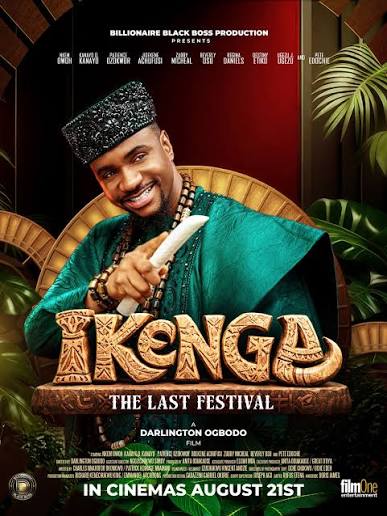
Ikenga: The Last Festival has crossed ₦75 million at the Nigerian box office. FilmOne describes it as the highest-grossing Igbo-language film yet recorded.
The milestone deserves recognition. The more useful question is what the industry can repeat.
Nigerian cinema has produced Yoruba-language theatrical hits and Hausa-language screen industries with their own audience systems. Igbo-language films have rarely received the same consistent multiplex positioning. Ikenga therefore enters the market as more than an individual cultural drama. It is a test of whether language can become part of a commercial release strategy.
The Opening Established the First Signal
The film opened on 21 August and grossed ₦22 million in its first three days, according to figures released by FilmOne Entertainment. The distributor described it as the largest opening weekend for an Igbo-language film in West Africa.
The initial result mattered because it arrived in a competitive corridor. Alahun: The Weaver and A Father’s Secret were among the domestic titles also entering cinemas. Ikenga had to secure showtimes and explain its proposition alongside other local releases rather than operate as the only Nigerian option.
The later ₦75 million total shows that the film continued to accumulate beyond the opening announcement. It does not make the title a national blockbuster by the standards of Nigeria’s largest releases. It does establish a new commercial reference point for an under-tested category.
READ ALSO: Call of My Life is challenging Nollywood’s dependence on the December corridor.
Language Is Not the Only Product
The easiest explanation is that audiences supported an Igbo-language film because they wanted to see their culture on screen. That is probably part of the result. It is not enough to explain a cinema run.
Ikenga packages language inside familiar commercial elements. Darlington Obodo Kelechi directs a story about power, forbidden forces and a community threatened by one man’s ambition. Pete Edochie, Nkem Owoh, Kanayo O. Kanayo, Patience Ozokwor, Zubby Michael, Beverly Osu, Jide Kene Achufusi, Destiny Etiko and Regina Daniels provide recognition across generations and audience groups.
The fictional kingdom of Umuani gives the film a world that can be communicated visually. Costumes, ritual, hierarchy and conflict help the marketing sell scale before a viewer hears a line of dialogue.
This distinction matters. Indigenous-language cinema will not grow through cultural obligation alone. Audiences still need genre, stars, spectacle, humour, fear, romance or another clear reason to leave home and pay for a ticket.
Subtitles Expand the Addressable Audience
An Igbo-language film is not commercially limited to fluent Igbo speakers if its subtitling and positioning are treated seriously.
Nigerian audiences already consume Korean, Indian and European titles with subtitles. Streaming has normalised movement between languages. The obstacle is less about the act of reading and more about whether the film is presented as an event worth the effort.
For distributors, that means trailers must communicate the story beyond dialogue. Subtitle quality has to be consistent. Cinemas need accurate listing information. Marketing cannot assume that a title will reach only the South-East or only viewers who already follow the cast.
The addressable audience includes culturally connected viewers, curious audiences elsewhere in Nigeria and diaspora markets where language can function as both identity and discovery.
The Missing Numbers Still Matter
The reported gross does not answer every commercial question.
FilmOne’s public milestone does not provide admissions, the number of screens, average ticket price, weekly theatre retention or the split between Nigeria and any additional West African markets. Gross revenue is also not producer income. Cinemas, distributors, taxes, marketing expenses and contractual recoupment sit between the box-office headline and the money returned to the production.
These limitations should not be used to dismiss the result. They should determine the claims made from it.
What can be said responsibly is that Ikenga opened at ₦22 million, passed ₦75 million and established a new disclosed benchmark for an Igbo-language theatrical film. What cannot yet be said is whether it generated exceptional admissions, produced a strong profit or reached the audience through a broad national release.
From Milestone to Slate
A market changes when a result affects what gets financed next.
If producers read Ikenga only as proof that audiences want another royal epic with veteran actors, the response will be imitation. If they read it as evidence that language can support a properly packaged theatrical proposition, the response can be broader.
Igbo-language crime films, family dramas, comedies, romances, thrillers and children’s stories should all be commercially possible. The industry needs development, casting and marketing strategies that treat the language as a creative base rather than a genre.
Exhibitors also have a role. A distributor cannot prove demand if the film receives weak showtimes or disappears before word of mouth forms. Screen allocation should respond to actual performance, but the opening window must be credible enough to produce a fair test.
Regional campaigns can support national distribution rather than replace it. Enugu, Owerri, Aba, Onitsha and Asaba matter, but so do Lagos, Abuja, Port Harcourt and diaspora cities where culturally specific films can operate as events.
The Commercial Test Begins After the Record
Records are useful because they create a number that the next production can challenge. They become less useful when every film is treated as a one-off exception.
The next evidence should be a second and third Igbo-language title receiving serious financing, wide subtitling, professional distribution and a release date selected for commercial reasons. The industry should then compare admissions, retention and marketing efficiency rather than relying only on cumulative gross.
Ikenga: The Last Festival has shown that an Igbo-language cultural drama can produce a meaningful multiplex result. The stronger achievement will be an industry that no longer treats that outcome as unusual.
Sources